Study @ France – Nashwa Nabihah

My name is Nashwa Nabihah binti Saiful Yazan and I am currently in my second year of Mechanical Engineering in IUT Grenoble, France. I am under the scholarship of Yayasan Telekom Malaysia for their Overseas scholarship programme in which I was offered France for their 6 years of Engineering programme. 

To be choosing France for my undergraduate studies, I would say it was more towards by chance instead of by choice but it was by far the best chance I have managed to grab. France is widely known for their engineering schools as this field of study is one of the biggest in the country and also on how they prioritize hands-on learning for the students. These are a few of the driving factors on why I chose France as my place for study. 

During my first year in France, which was in 2018, I had to go to a preparatory school for a whole year where I studied French and science-based subjects which were Chemistry, Physics, Mechanics and Mathematics in order to be able to apply to the universities here. It is required for the international students to be certified with a level DELF B2 for their French language and to score a minimum of 12/20 for their overall performance during their preparation year. Thus, I would say that the preparation year was more towards getting use of French as our first language of study and performing well in DELF.

The university application was done by one of our professors in which he would request the students to shortlist a maximum of 3 choices of university and their desired course. He/she would then look into our results for both semesters before proceeding to send our applications. We would be given a few words of advice from the professors regarding our performance and their recommendations on our desired course. In general, the university applications differ from one university to another. As for me, my application required my results from both semesters and they would process it themselves and reach back to me within 3 months for my application result. For some of my friends, they had to undergo a phone interview with their university and submit a Personal Statement as a mandatory process for the application. I have chosen IUT Grenoble as my first choice to pursue my studies as this university is ranked as one of the top 5 best universities in France and they are known for their practical class experience as they are equipped with advanced robotic technologies and fabrication machines. Grenoble is one of the best student cities in France where there are many students’ residences with an affordable living cost for the students compared to other big cities in France (e.g. Paris). The location is also a driving factor for me as it is located at Auvergne-Rhône-Alpes, a region famous for its plethora of mountains, ski resorts and national parks that can be discovered for a nature enthusiast like me.

My university application to IUT Grenoble was successful as I had met the minimum requirements of my semester’s examination. All in all, the pushing factor would be on how interested I was to be pursuing Mechanical Engineering in their university and that was why I have worked hard in my Mechanics and Mathematics during my preparation year. My advice is that it is crucial for the students to do well during their preparation year, especially on subjects on which course they would want to pursue for their upcoming years because it would add as an extra point as to why they would have to accept your application.  Most importantly, focus on your progress in French language as it is very much required as the classes in university are all being done in French. With all of these and endless determination, everything will be eased for your future application into French universities!


Nashwa Nabihah is currently a second year mechanical engineering student in IUT Grenoble (Batch FP19). She is sponsored by Yayasan Telekom Malaysia and loves cappuccino more than she loves herself.

Financial Aid for US Universities

Disclaimer: This article was originally written by Annabelle Ooi in 2014 and reviewed/edited by the CollegeLAH team in September 2020

uat_026960

Image Source

FINANCIAL AID PART ONE: JARGONS & CHOOSING UNIVERSITIES

Hello prospective Class of 2019 (and later)! I am Annabelle, a sophomore at Mount Holyoke College. When I applied to American universities, I remember being overwhelmed and frustrated (well… mostly frustrated) by its tedious financial aid application process, a phase I am sure most of you are going through right now. I hope my article does its part in tiding you through the process.  

Before we begin, let’s get our terminology straight.

Scholarships (merit-based) versus Financial Aid (need-based)

Merit scholarships are awarded based on merit on the nature of academics/extracurriculars. On many cases merit scholarships alone might not be sufficient to offset the total cost of attendance because they are not tailored to a student’s financial need. However, note that one or more merit scholarships can also be part of a need-based financial aid package.

Need-based financial aid is offered based on your financial need, i.e. the difference between the total cost of attendance of a university and how much your parents/guardians can afford to pay. A typical need-based financial aid package is comprised of one or more of the following: grant, merit scholarship(s), student loan and work-study.

State/public universities generally offer only merit scholarships for international students whereas private research universities and liberal arts colleges usually offer both need-based aid and merit scholarships. UC schools do not offer financial aid for international students but if students are selected for Chancellors’ and Regents’ scholarship after getting an offer, their full financial need will be covered. – include this. Some schools also offer 90% scholarship/financial aid, so you only need to pay just $1000-2000 per year. 

Need-aware versus Need-blind

Universities that offer need-based financial aid are either need-aware or need-blind.

Need-blind universities are universities that do not consider your financial need when deciding your admissibility. In other words, applying for financial aid will not “hurt” your chances of being admitted to these universities. Conversely, universities that are need-aware will take into account the fact that you applied for financial aid when considering you for admission.

**In case you still have trouble differentiating the terms I introduced, keep in mind that the word, “need-based”, describes a financial aid policy, whereas the terms, “need-blind” and “need-aware”, are used in relation to admission.


POP QUIZ!

Drawing from what you read earlier, if you are admitted and offered a need-based financial aid package by a university, you now have the financial means to attend this particular university. Is this true? (You have 5 seconds to scroll back and check if you dozed off reading just now.)

*
*

*

*

*

*

The answer is no. (“What?! But you said […]”) Okay, to be fair, that was a trick question. Note that not all universities that offer need-based aid promise to meet 100% demonstrated financial need.


Need-based versus Meets Full Need

Some people might have a hard time differentiating between the concepts of need-based and meeting 100% demonstrated need, so I am going to show some calculations below in regard to this.

Say you, an aspiring scarer, applied to Monsters University and got admitted with a need-based financial aid package.

Total cost of attendance for Monsters University: USD 58000
MINUS
The amount your parents can afford to pay: USD 9500
EQUALS TO
Your financial need: USD 48500
(This is how much financial aid Monsters U should offer you in order for you to attend)

However, Monsters U does not promise to meet full need.

Monsters U adcoms are aware that you need USD 48500-worth of financial aid in order to enroll but unfortunately the university does not have sufficient funding, so you are awarded USD 30000 in financial aid and have until May 1st to decide if you want to enroll.

****** 10-minute water break ******

Choosing universities

The ideal university for a financial aid applicant would, of course, be one that offers need-based aid, is need-blind in terms of admission and promises to meet 100% demonstrated financial aid. Sounds too good to be true? Well, good news for you – they do exist! As of now, there are six need-blind universities in the States that meet full need: Amherst, Harvard, MIT, Princeton and Yale. (Technically, Amherst is a liberal arts college, but for the sake of consistency I will maintain the usage of the term, “university”, in this article.)

“But… as financial aid applicants, we don’t only have five universities to choose from, do we?”

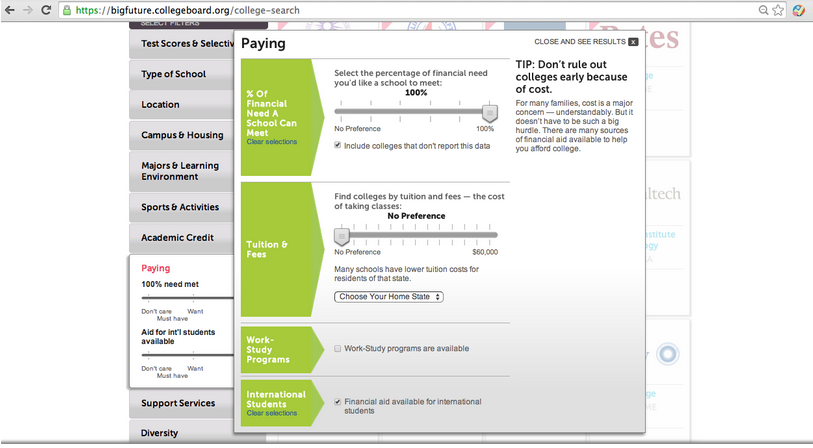
Of course not! There are many universities in the States that, albeit being need-aware, offer need-based aid and promise to meet full need upon admission. When I applied, I had the fortune of stumbling upon a website that had an almost comprehensive list of need-aware, full-need universities. Click on ‘Paying’ on the left-hand side and set the filters to “100% financial need met” and “financial aid available for international students”, voilà – some 69 universities miraculously pop up.

Screen Shot 2014-10-18 at 1.06.56 PM

There are, however, two shortcomings about this site:

  1. There is a very rigid toggle limit for the %-of-financial-need-a-school-can-meet function. The next percentage down from 100 that you can select is 80. Even schools that meet 99.9% need, only 0.1% down from full need, will be ruled out if you set the filter to 100%. I believe that universities that meet more than 98% of financial need should not be ruled out because, speaking from personal experience, there is always the possibility of appealing/negotiating for more aid upon admission.
  2. Some universities don’t report data on financial aid.

FINANCIAL AID PART TWO: APPLICATION MATERIALS

For international financial aid applicants, you typically submit the CollegeBoard CSS/ Financial Aid PROFILE or the International Student Financial Aid Application (ISFAA). Sometimes the Certificate of Finances (COF) is required along with the ISFAA. In rare cases, some universities, like Bates, Franklin & Marshall, Hamilton and Middlebury, use their own financial aid application forms for international students. In addition to your main financial aid application form, most of the time universities will also ask for certified copies of your parents’ statements of income and tax return forms.

  • CollegeBoard CSS/ Financial Aid PROFILE (Base fee of USD9 + USD16 per university)

This is an online form and the only form that allows you to fill in amounts using Malaysian Ringgit. If you are applying to universities that use a combination of PROFILE and ISFAA and/or COF, I suggest you start with PROFILE and plug in the numbers using the current exchange rate to other forms later.

  • CollegeBoard International Student Financial Aid Application and (sometimes) Certification of Finances (free of charge)

These forms come in .pdf format so you can either complete these forms with Adobe or print them out and fill them in manually. Everything in both forms should be completed in USD.

  • Statement of Income

This would generally be your parents’ monthly pay slips. If they are not in English, translate them into English and have your parents’ employers certify the copies. Companies have these in soft copies – so ask your parents to try to get the soft copies for translation purposes. It does not matter in which currency the amounts are denominated as long as the currency used has been clearly stated. There is no specific requirement as to how many monthly pay slips you should submit, but I submitted three consecutive ones for both parents.

Back when I applied some universities asked for an annual statement of income instead of monthly statements. Neither of my parents’ companies had one of those, so I printed the numbers on my parents’ company letterhead and had my parents’ employers certify them. Below is a template for this in case any of you ever need it.

To Whom It May Concern,

Verification of Annual Income and Taxes Paid in Year 201X

I hereby verify the details of my employee, XXXXXXX as followed:
a) Total Amount of Income Received in Year 201X: RM XXXXX
b) Total Taxes Paid in Year 201X:  RM XXXX

Yours faithfully,
XXXXXXX

  • Tax Return Form

For parents who work in private sectors in Malaysia, this would be the EA form. If you have to translate this form, an English version is readily available in .pdf online. Again, your parents’ employers need to certify these.


FINANCIAL AID PART THREE: MINIMIZING APPLICATION COSTS & OTHER TIPS

The financial cost of applying to American universities can add up, and it doesn’t help that we have to multiply everything by 3.20 or so. Here’s how to not break your (parents’) bank on your way to ‘Murica:

1. Have your college application fee waived (You save:USD 60-80 per school)

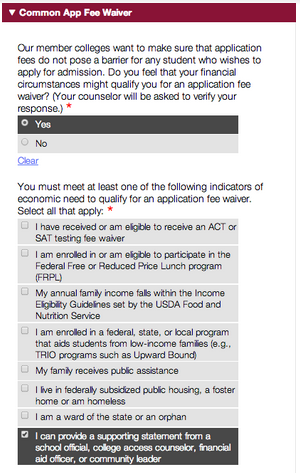
Have your school counselor write an application fee waiver request on your behalf, attesting to how the application fee is going to put a strain on your family’s finances. Support with evidence like your annual household income, number of dependants in your family, the total cost of application you have to pay and the current exchange rate. Alternatively, you can write it yourself and have your counselor certify it.

How to submit your college application fee waiver request:

Most colleges want you to mail it physically. However postage can be costly (not as costly as the application fee, but still.) so I asked my counselor to scan and attach the waiver request within her online recommendation letter. For schools that specify they need to receive a fee waiver request before you apply, you can always try sending them a scanned copy of the fee waiver request, explain how posting it will strain your family’s finances, ask if they can accept the scanned copy for now and promise that you will have your counselor send it online along with the rec letter.

How to submit Common App with a fee waiver:

Screen Shot 2014-10-18 at 1.16.26 PM2. Have your test scores sent through counselor (You save: RM100 for IELTS per school and USD11.25 for SATs per school; not sure about TOEFL)

In order to do this, you need to write to individual schools and ask in advance, or schools will deem your application incomplete. You don’t need a formal letter like the fee waiver request; just shoot them an email stating how sending scores via CollegeBoard/ETS/IDP will strain your finances and ask if it’s possible to send them via your counselor instead.

Which score report to submit:

CollegeBoard doesn’t provide you with a physical copy of your SAT test score report unless you request and pay for it. Instead of doing this I downloaded the Online Student Score Report that is available free-of-charge to everyone who has taken the SAT and had my counselor submit the first page of both my SAT I & SAT II reports. There will be a watermark that says “NOT AN OFFICIAL SCORE REPORT” embedded somewhere highly visible on your online report, but fear not – this report will be considered official by most schools once your counselor stamp and certify it.

Where your counselor should attach your test scores:

If you have all your scores ready by the time your counselor submits the Mid-Year Report, have him/her attach them in the Mid-Year Report. Otherwise, wait till all your scores are in and have your counselor submit an Optional Report. I would suggest that you consolidate all test scores and submit them in the same report, i.e. either the Mid-Year Report or the Optional Report. Submitting them separately can be very confusing for the adcoms, and they are already doing you a favor by accepting these score reports via your counselor (this means the extra workload of entering your scores into the system manually), so be considerate!

3. Have your PROFILE fee waived (You save: Base fee of USD9 & USD16 per school)

You do this in two ways:

  • Ask for a PROFILE fee payment code by explaining your financial hardship

For reference, schools that provided me with a code were Amherst, Colorado, Cornell, Duke, Lafayette, Mount Holyoke, NYU and Skidmore. Not all schools offer a fee payment code, though. And if they don’t, go for option b.

  • Ask if they accept the ISFAA and COF in lieu of the PROFILE

Schools that I applied to had varied responses to this. Some agreed to it; some didn’t but agreed to hold off my PROFILE requirement until (if) I receive an admission offer; others sent me their own financial aid application form that they reserve for only students who cannot afford the PROFILE.

4. Have your financial documents (e.g. parents’ statements of income and tax return forms) sent electronically (You save: Whatever postage costs)


Additional Notes:

  1. The bulk of what I wrote above applies only to those with lower/mid-level household income. If you do not fall under this category and attempt to abuse these fee waivers by misrepresenting your application, know that in life what goes around ultimately comes around.
  2. When approaching the schools for waivers, be polite but persistent and assertive. You will be surprised at what you can get simply by asking.
  3. Financial aid applicants should also consider the availability of funding for unpaid summer internships and study abroad programs in a particular university before applying. This might not seem as important at the moment, but – trust me – it will be highly relevant in a year or two.

imageedit_12_5488586403

Annabelle Ooi is a neuroscience major in Mount Holyoke College. She is probably one of the few unartistic left-handers in this world who can’t draw and is tone-deaf. Feel free to email her with questions on financial aid, NeXXt scholar program, liberal arts colleges and life in an all-women’s college.

Life @ Epsom College

When I first started joining Epsom, I was afraid that I wouldn’t have any friends but turns out Epsom is more welcoming than I expected. Having been in a boarding school before, I was very used to boarding but Epsom gave me more of an experience. I decided to take the opportunity to be a full-boarder meaning that I would be spending most of my weekends in school instead of going back home weekly (I live an hour away from Epsom). This is because Epsom provided me a lot of opportunities and top-notch facilities in order to develop my soft skills. I am proud to say that I am at least 10% better at sports now than I was before joining Epsom. Apart from that, I also got the chance to continue my passion for music. On weekends, I would be in the music room in Propert House playing the piano despite the fact that I did not sign up for proper music sessions (which you could if you are very passionate about music).

I was worried about transitioning into a new school but the people in Epsom are very welcoming and supportive. Due to its small community, everyone knows everyone here basically. You can always ask for any help and there will be somebody that will be coming to you to assist you. The Sixth Formers here in Epsom are very helpful and fun! We all work hard but we play hard as well! There are a lot of social events too – Christmas dinners, music concerts, drama performances, Epsom Edge and the Year 12 Midway Dinner. This is a great platform for students to socialise with others and build networks.

During my time in Epsom, I also got involved in activities outside the college, which was heavily supported by the school. For instance, I got the chance to be a part of the college’s winning ASA Viva team in which we won 1st place and RM500. The team consistedof 5 students (including myself), where we had to conduct research about the public healthcare system in Malaysia and what could be done to bring more equality and fairness into it. This was certainly very challenging as we had to present it in a viva presentation to Dr.Greta from Exeter University. This taught me the values of teamwork and the techniques needed in researching. These values will help me a lot in university later on in my life.

In Year 12, I was involved with the college leadership team – having joined the College Committee. Fast forward to Year 13, I was appointed as the college’s new Academic prefect for the next academic year 2019/2020. I was very excited and couldn’t wait to start contributing to the college to assist the staff and students in Epsom.

So how was it like to be at one of the most expensive private international schools in Malaysia?

To be very honest, it was an enjoyable experience. It felt very posh, and at first, it didn’t feel like a school. It was more like a daycare centre, having comfortable en-suite rooms and buffet-style meals. But then again, it was indeed stressful because of the college rules and regulations ; you can’t do this, you can’t do that. Most of my teachers were British so it took a while for me to understand but I am proud to say that I managed to adapt myself. There were times where it was problematic, having to change teachers every term but hey, you just need to be a little bit more independent. Definitely a different experience to my previous public all-boys boarding school life.

I would have never pictured myself to be spending the last few days of A-Levels at home. With the whole COVID-19 pandemic situation going on and a myriad of national Movement Control Order restrictions being imposed, I missed the chance to properly bid farewell to the people who were there for me throughout my 2 bittersweet years in Epsom College. Indeed, it was one hell of a ride. Ups and downs. Failures after failures. Countless of heartaches and misunderstandings. Disappointments and sorrow. Nonetheless, I consider these to be a huge part of my character development and for that I am forever grateful.

Most memorable experiences?

Throughout my 2 years, obviously I focused most of my time on academics. For your information, I took Mathematics, Further Mathematics, Economics, Politics and EPQ. Fun Fact: Epsom is the only college in Malaysia that offers A-Levels Politics! The thing is that when you’re enrolled in a ‘sports’ school like Epsom College, you can never avoid doing sports. Don’t get me wrong, I never hated sports, in fact I enjoy them but I just didn’t have the courage (and time) to do any? But then again, being in Epsom, I took the opportunity to get out of my comfort zone and actually joined various sports. I participated in House Football, Rugby, Basketball, Badminton, joined gym classes, swimming, archery and took some martial art classes. I also managed to lose some weight since joining Epsom partially because of the sports. Ever since Christmas dinner in 2018, I started a pescatarian diet (someone who only eats veges and seafood) and proud to say that I am still on the diet.

Apart from that, I definitely enjoyed meeting new people and socialising with a bunch of different people with different ethnicities and backgrounds. Don’t worry if you live far away from home and planning on to join Epsom! Here in Epsom, we celebrate every festivals and cultural events; Eid-ul Fitri, Chinese New Year, Deepavali, Christmas and etc. Epsom College embraces all the students and the diversity they bring to the school. With so many different festive celebrations, you will get to understand more about other people’s culture and in a way, experience a whole new different environment. With the newly established International Prefect post, students coming from other countries can seek help and guidance if you ever feel homesick or in need of any assistance. Epsom Prefects are really nice people! Trust me, I was one!

I spent 5 years in an all-boys public boarding school before joining Epsom so obviously it feels awkward having to see girls at school (maybe just me). Nonetheless, I am totally grateful for being at Epsom I guess, it felt like a training ground for me before going to the UK for my studies.

Student Support?

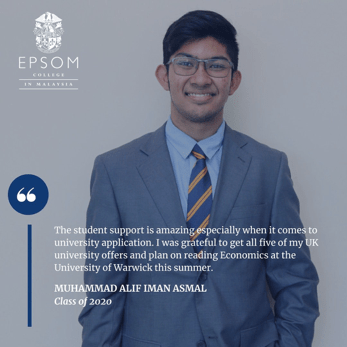
My experience in Epsom was wonderful despite being here for only 2 years. Throughout my A-Level journey, Epsom has provided me more than just quality British education, I was exposed to many doors of opportunities. The student support is amazing especially when it comes to university application. I was grateful to had gotten all 5 of my UK university offers and plan on reading Economics at the University of Warwick this summer. In Year 13, I was appointed as the Academic Prefect, this gave me the chance to enhance my leadership skills and, in a way, it helped me understand the meaning of teamwork and communication. Best part of being in Epsom College is the community here. Settling in Epsom was not a problem because the housemasters and housemistresses really take good care of you. There will always be somebody that you can talk to whenever you’re feeling down in the dumps. Even with the current Covid-19 pandemic going on, I was still able to attend all my classes virtually. The teachers were very committed and determined to carry on with lessons despite being far apart from the students.

In a nutshell, Epsom College provided me the opportunity to step out of my comfort zone and broaden my horizon. A-Level is more than just academics. What’s important is how you enhance your soft skills and at the same time grow as a person. I am so grateful to spend my 2 years of A-Levels in Epsom College because of the amazing student support and facilities. Surely I will recommend 10/10!

Scholarships Available If You Are Interested !!!

Good grades in SPM/IGCSE? Have a talent for sports and music? Then why don’t you apply for an Epsom College Scholarship! You can either apply for the academic, sports, music or the prestigious Tune Libra scholarship in which you can be waived 100% from your tuition fees! Check out if you are eligible for any of the scholarships listed @ Epsom College website.

Link – https://www.epsomcollege.edu.my/admissions/scholarships-and-bursaries/academic-scholarships/


Muhammad Alif Iman did his SPM in Sekolah Sultan Alam Shah (SAS) and completed his A-Level in Epsom College (ECiM). He’s currently reading Economics @ The University of Warwick, UK (Class of 2023).

CollegeLAH’s Guide to Using Common App


Creating your CommonApp account

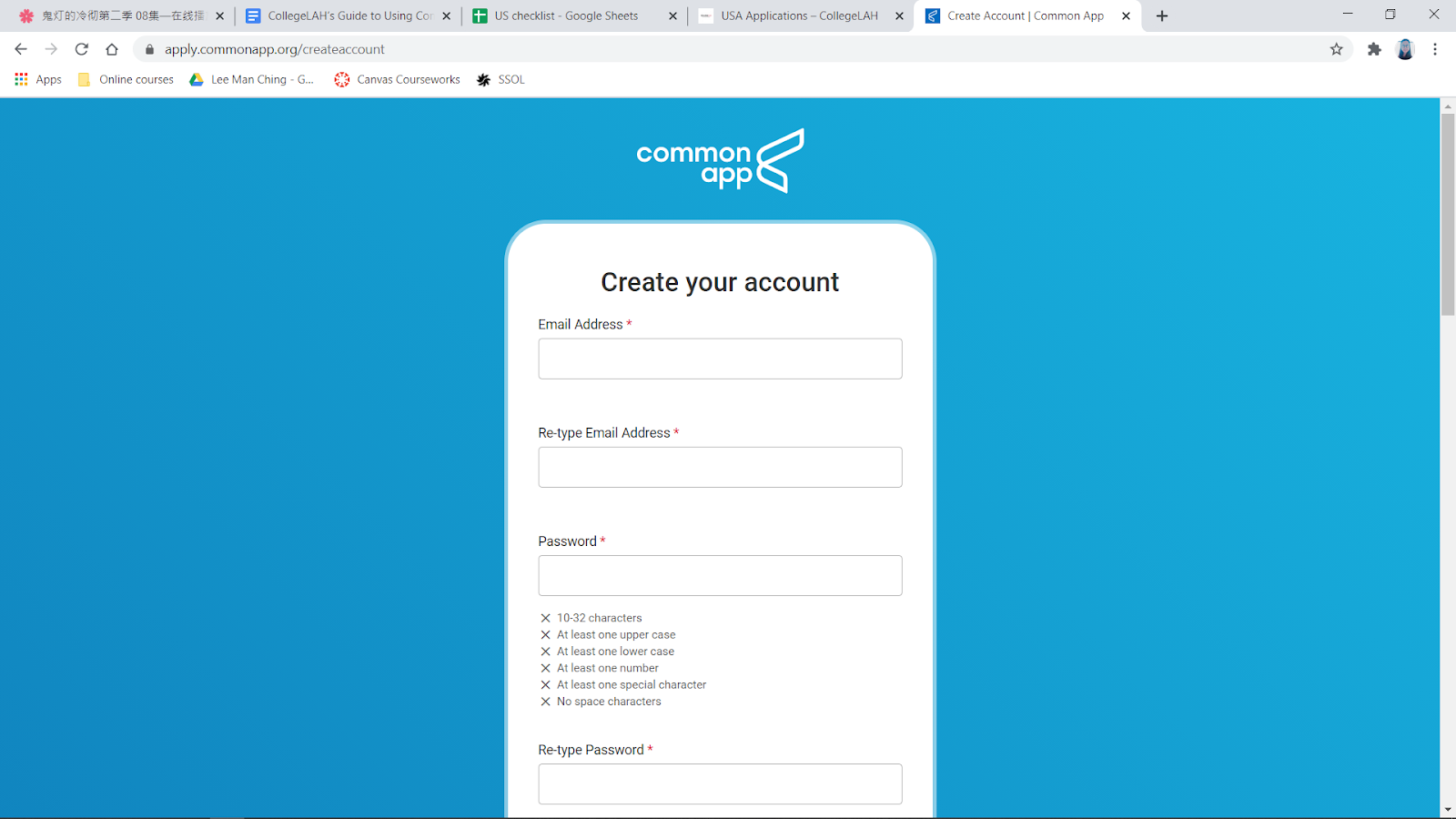
  • Go to https://apply.commonapp.org/createaccount and select “First Year Student”. This will lead you to the next page to create an account. Fill in the required questions which should be self-explanatory.

  • Once you are logged in, you are able to view your Dashboard and your full CommonApp Account.

Your CommonApp Account

  • Your CommonApp Account is separated into five functions: Dashboard, My Colleges, Common App, College Search and Financial Aid Resources.

  • Dashboard: The Dashboard is the central monitor to your applications. Once you have added colleges to your applications, you will be able to view them on the dashboard, showing you the deadlines, requirements and your progress. You may also remove the college you chose here.
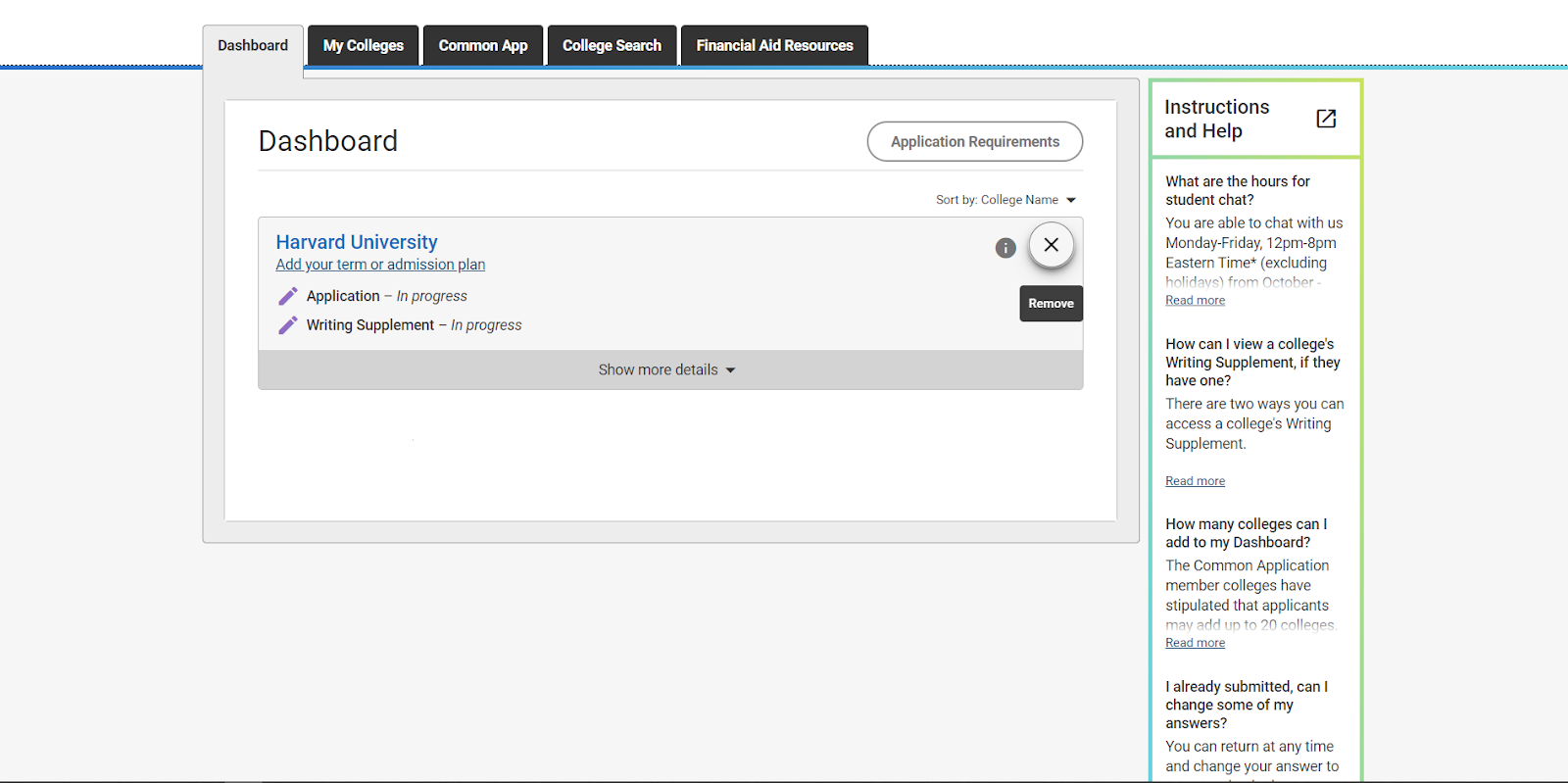
  • My Colleges: The My Colleges tab shows the colleges that you have added into your account. You will complete your work for each specific college here. Some colleges will require extra essays or questionnaires answered.
  • Common App: This is where you will fill up general details which are required for every college you are planning to apply (you will only need to fill up once regardless of the number of colleges you apply), from your profile, family members’ information, educational background, standardized testing results, your high school extracurricular activities to your Common App Essay.

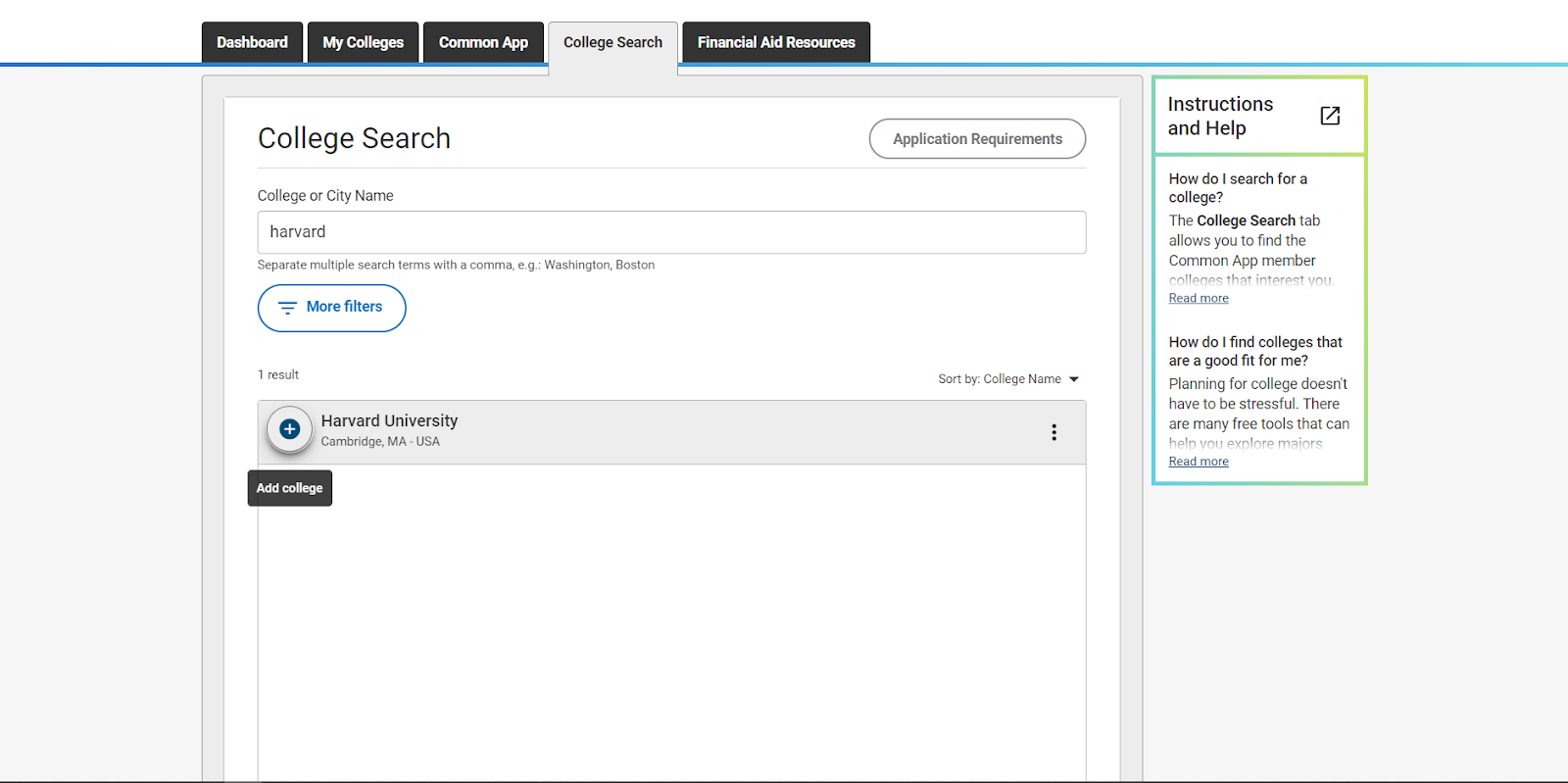
  • College Search: College Search allows you to search for colleges/universities by different criteria, i.e. by name, country, state, term, applicant type or deadline. By clicking the “add college” button, the information of the particular college will become available on your “Dashboard” and “My Colleges” where now you will be able to check out and answer the supplemental questions required by the college.
  • Financial Aid Resources: This tab provides a general guideline for the financial aid made available by the US government. It might not be applicable for most of the international applicants. For more financial aid information (ie. how to apply for college-specific financial aid), please refer to the CollegeLAH US Application Financial Aid section.

The Common Application

Profile

This is the part where you fill in everything about yourself – name, address, contact details, demographics, geography, languages, citizenship, scholarship information, and common app fee waiver. It provides the most basic understanding of who you are to the admission officers. Most of this section is very straightforward but we will clarify the bits that might not be.

Common App Fee Waiver – Nothing in this world is free. Likewise, applying via Common App costs money as well. However, if you think that you face sufficient financial difficulties such that you might be unable to afford the application fees, then you can apply for the fee waiver. Your counsellor will be contacted to provide evidence of financial difficulties so don’t try to cheat.

Family

This is also a relatively straightforward section, where you are required to fill in information about your family background. It is divided into 4 subsections: Household, Parent 1, Parent 2, and Sibling. You will need their basic information such as name, age, occupation, country of birth, education level etc.

 Education

This is where things get gradually more confusing. You will provide your educational information here, from secondary school to your Pre-U studies. Here’s a clarification that will be useful for most readers here, especially if you’re from Malaysia. Even if you are enrolled in some pre-U courses such as ADP, A-levels, IB etc. in, for example, Taylor’s College, KDU, INTI University, you are indeed still in “high school” and it will be seen as something similar to the Grade 12 and 13 under the US education system.

Hence, under the “Current or most recent secondary/high school”, enter the information of your pre-U college instead of your high school which you did your SPM, IGCSE and so forth.

Current or Most Recent School: Unless you’re studying at a school in the USA or US Territories, your school might not be listed here. Search for your school’s name and if it does not appear, select “I don’t see my high school on this list”. Likewise, if you are homeschooled, select the “I am/was homeschooled” option. 

Other School: If you are doing your pre-U education in a different institution as compared to your secondary school, you will need to fill up this subsection. Just do exactly the same as the previous step for each high school you have attended. That said, please do not key in your primary school and kindergarten. Likewise, given that high school means the schools where you did SPM/IGCSE till IBDP/A-level/STPM/Matrikulasi/AP, please do not include your PMR school if it was different from the one you did your SPM/IGCSE at. Otherwise, please do. An example of how you can provide details about why you left each of the above secondary/high schools: I left the above secondary school after I finished the Malaysian Certificate of Education (Sijil Pelajaran Malaysia/ SPM).

College & Universities: If you have completed a university level course, be it online or through a physical college, fill up this subsection. For the occasional Singaporeans who might be reading this, declare your H3 Subjects here. Likewise, if you have completed an actual uni/college level course, declare here. Please keep in mind that your Pre-University education (A-level, IBDP, STPM, Matrikulasi, AP) does not count here.

Grades: Fill in the information based on the current school you are in. If you are on a pre-U programme that does not use GPA/CGPAs (A-level, IBDP), leave the relevant sections blank. Likewise, if you’re doing Matrikulasi or STPM, declare your CGPA as well as the GPA scale (‘4’ for STPM, Matrikulasi etc.) Whether or not your GPA is weighted depends on this question – do all contributing subjects/modules/aspects have the same individual contribution to your GPA? If your answer is no, then your GPA is probably weighted.

There are 4 options under the class rank reporting, mainly
1) Exact: For instance, 53 out of 187 (187 will be filled in under “class size”)
2) Decile: Top 10%, 20%, 30% … 
3) Quintile: Top 20%, 40% .., 80%
4) Quartile: Top 25%, 50% … and so on.

Community-Based Organization: If any of these organisations helped you with your Common App application, then do declare them. These are generally non-profit organisations that are representative of particular civil societies e.g. Black communities, underprivileged suburban children. 

Current or Most Recent Year Courses: This is where you declare your Pre-University subjects as well as your Year 11 subjects (SPM, IGCSE etc). In other words, A-level History counts as one course, STPM Ekonomi counts as one course.

Honors: If you have won awards, competitions or scholarships, declare them here. Important point to note here is the grading system, Grade 9 refers to Form 4 and equivalent, Grade 10 being SPM/IGCSE while Grade 11 refers to your AS-level. Intuitively, Grade 12 is your A-level/IBDP/STPM. The exception here then is that if your pre-U course lasts only a year e.g. Australian year 12, SAM, Matrikulasi. In that case, Grade 12 refers to that and Grade 11 refers to IGCSE etc. Basically, it all depends on the number of academic years your Pre-U studies contribute to. PG generally applies to those who undertook gap years.

Future Plans: Write about your future career plans and highest degree you intend to earn here.

 
Testing

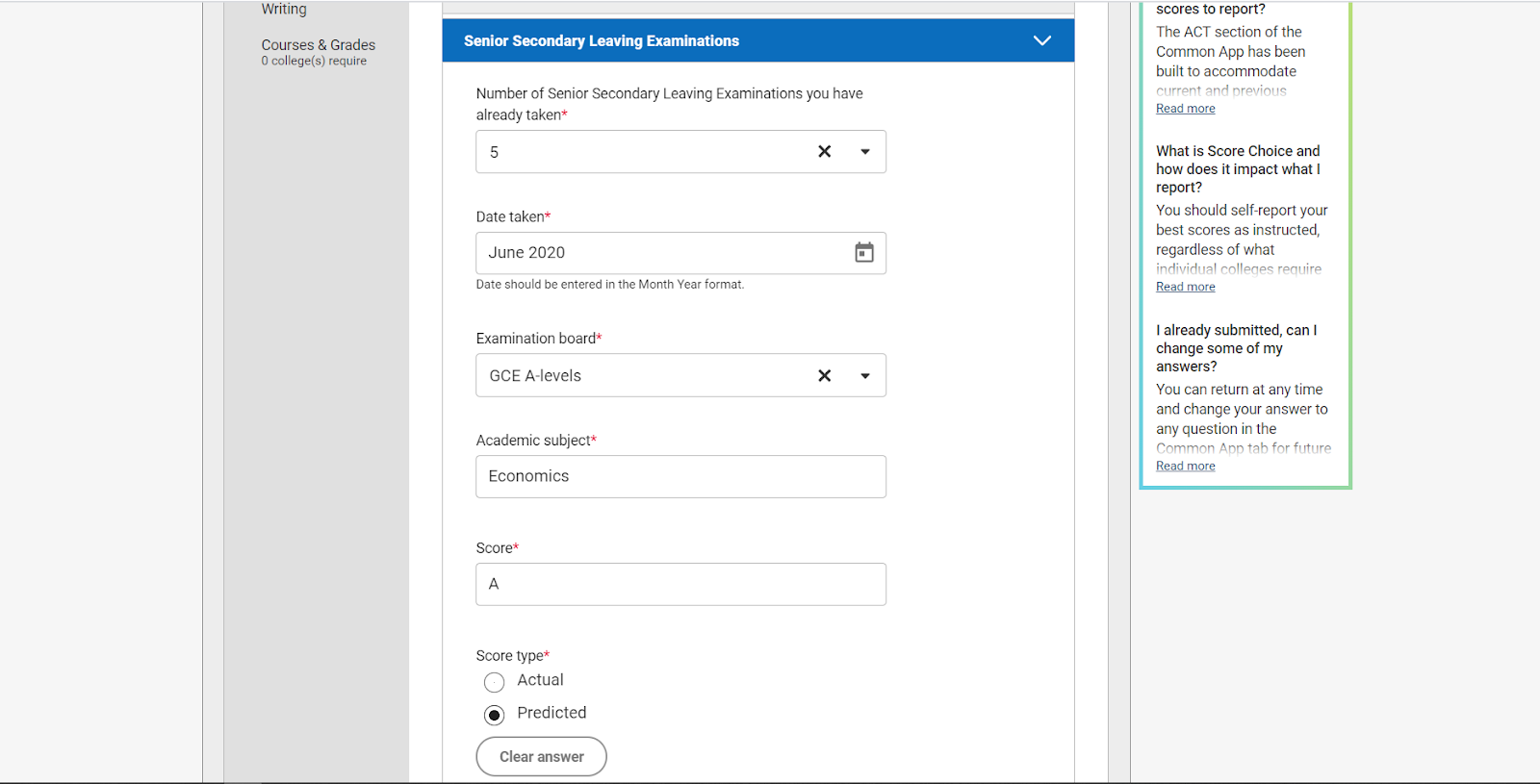
Test Taken: Check ‘yes’ to self-report your SAT, SAT II, IELTS, TOEFL, IB, A-levels scores. You should list all tests that you expect to take and have already taken. When you have chosen all the exams, they will come out as new tabs on the same page (“Testing”). Fill out the required information under each tab which should be self-explanatory.

If you have taken courses such as SPM, STPM, IGCSE, IB Middle or IBDP, elect ‘yes’ for the last column with the prompt: “Is promotion within your education system based upon standard leaving examinations by a state or national leaving examinations board?” Do note that if you took AP, you do not have to check this box.

Senior Secondary Leaving Examinations: If you check ‘yes’, a new section indicating “Senior Secondary Leaving Examinations” also comes up. For each test chosen, another column will appear; this is where you should fill in the specifics of each test. This means that if you have already sat for your A-level (including AS-level), IBDP, STPM, then tick “yes” and fill up accordingly. For most, who are still studying for the actual examinations, tick “no”.
 
Activities

After indicating ‘yes’, you have a maximum of 10 columns for you to fill in all activities. You’re given a maximum of 50 characters to state the name of the activity, and another 150 characters to describe the activity. Once again, please take note of the grade level system (may refer to the “Honors” section). If you are taking a gap year after your Pre-University studies, any activities done after graduation come under “Post-Graduate”. 

For sports specifically, if you are in your school/state/national team, then you are involved in “Varsity/JV”. If you are not in the main team i.e. recreational, secondary or development team, then you are in “Clubs”. Please also take note you are required to list the activities in accordance to their significance to you.

For example:

Music Club – Founding President

Spearheaded 2 national music concerts; raised $10,000+ for the Malaysian Elderly Association. Honed leadership skills working with 60 members.  (142 characters)

Keep your description concise to minimize character count and convey your message clearly. You might want to consider carefully which activities to include as this section is vital in portraying who you are both as a student and as a person. It is highly recommended that you state activities that you are interested in continuing in university. You may include your experience in internships or volunteering or even hobbies if you feel that you have gained a lot from these activities.


Writing

Personal Essay

You have a choice of 7 prompts to choose from. Choose one from the list below:
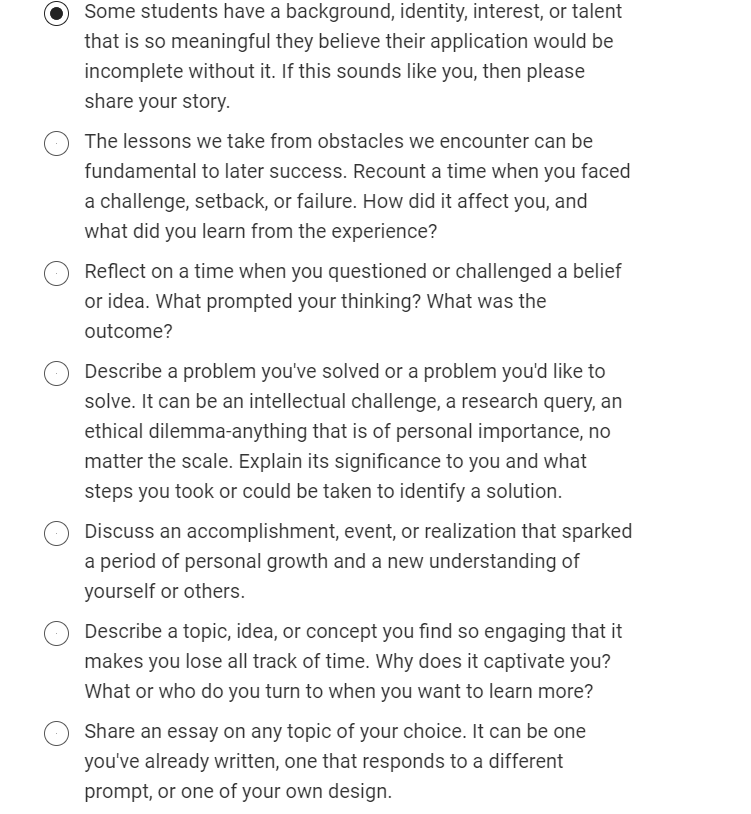
Our advice would be to briefly write down the main outline of your response to each question. With this in mind, you can roughly compare the quality of your responses across all questions. Try not to overthink the process; choose the essay that gives you the right platform to best express yourself. Ultimately, this is where you have the opportunity to showcase your unique identity and personality.

Please also find https://collegelah.com/2014/08/07/how-to-write-successful-us-college-application-essays/ here some more detailed tips on writing US college application essays.


Disciplinary History

Honesty is the best policy! Do not be afraid if you have a tainted disciplinary record. This does not mean that you will be rejected solely based on this.

 Additional Information

It is not necessarily the case that your application would be in any way disadvantaged if this section is left unfilled. If there is nothing else to add, there is no need to include unnecessary details.

However, if you do wish to include additional information, here are examples of what could be added:

1) Description of the 11th extremely important activity (because you can only write about 10 activities in the previous section)

2) Clarification of extenuating circumstances –

“Took a gap year after Year 11 because …”

“SAT scores were unusually poor because…”

“Discontinued a music syllabus after Year 10 because…”

3) Information regarding yourself that you think the application will not be complete without. However, please do not continue your unfinished essay here.

That is pretty much the information you need to know in order to complete the Common App. Congratulations on completing this CommonApp section! The specific questions under each college tab should also be straightforward to you. As for the supplemental essays, don’t freak out! CollegeLAH essays editing services are here to help you!

Some extra tips: 

Recommenders

Under the tab of every college that you have added to the “My College”, there will be a subsection called “Recommendations and FERPA”. This is where you invite your teachers to be your counsellor and recommenders. You will need to go to each college tab to invite them manually and some basic information about your teachers here such as their full names, phone numbers, emails etc.

Normally, students will invite 1 counsellor together with 2 (or 3, although less likely) recommenders. If you’re studying in an American-styled school, you should have a designated school counsellor. Otherwise, this can be any teacher or academic staff member who has good knowledge and understanding of the non-academic aspects of you. Therefore, it is entirely up to you whether you want a teacher from your secondary school or one from your pre-U school to be your counsellor. Common App references are significantly different from what usual Malaysian references would be, so be sure that your counsellor knows about the writing style.

As for teacher recommendations, it is advisable to invite one teacher from a science subject and the other one from a humanities subject to showcase a broader picture of your overall performance in school. Likewise, you can also have non-academic referees e.g. sports coach, music tutor (more relevant for those applying for sports/music scholarships). Similarly,it is entirely up to you whether you want a teacher from your secondary school or one from your pre-U school to write your teacher recommendations.

Waiving your FERPA rights means that you agree legally not to have access to your references or transcripts and have your counsellor send them on your behalf. Please note that once your recommender is invited into your application for a particular university, his/her reference can also be used for all other universities you are applying.

Bank Negara Undergraduate Kijang Scholarship (Khalif Shahriman)

Back in 2019, on the 4th of July, I was invited for the BNM’s Undergraduate Scholarship Assessment at Sasana Kijang. This was actually my 2nd time applying for the BNM Scholarship, after failing to get called for the assessment post-SPM in 2017. 

I won’t lie about being super nervous for this because I had previously 2 other interviews from other scholarship bodies where I did not make it to the next stage. So, when I reached Sasana Kijang, I was really surprised to see just a few other people at the lobby with me, it was something that I definitely did not expect. There were only about 16 of us that morning and it remained like that throughout the day. We managed to mingle a little bit at the lobby before BNM’s representative brought us up to the meeting room, and it was nice to see new faces as well as some familiar faces! If I recall correctly, there were 4 people who were going to pursue Law, 4 for Economics, 4 for Actuarial Science, and 4 for Accounting & Finance. This may have just been a coincidence though!

So this was the agenda as per the email that they sent to us;

Time Details
8.30am – 8.55am Panel & Candidate Briefing
9.00am – 9.45am Group Activity 1
9.45am – 10.00am Morning Tea Break
10.00am – 11.30am Group Activity 2
11.30am – 11.40am Comfort Break
11.40am – 12.00pm Preparation for Individual Presentation
12.00pm – 1.20pm Individual Presentation and Interview
1.20pm – 2.20pm Lunch Break
2.20pm – 6.20pm Individual Presentation and Interview

Group Activity 1: Icebreaking

From the lobby, we were brought up to one of the floors where they had a few meeting rooms. We had an area for us to talk to each other before the panels arrived. We were then split into two different groups and separate meeting rooms according to the grouping. In my room, we had 5 panels and 8 candidates including myself. The first group activity was an ice-breaking session for everyone, which had no ‘weightage’ nor any assessment to it. 

After the ice breaking session, we had a short morning tea break where we met panels from the other group for a short chit-chat session over coffee/tea and curry puffs. The panels were really nice and friendly (for now) throughout the break but it was also important to make sure that we were not too lepak at the same time.

Group Activity 2: Group Presentation 

For the next activity, there was another group activity with actual assessment. Split into 2 groups again, we were given the responsibility to open our own kids theme park! It was interesting because we had to ponder over selecting different features with their own perks and consequences, as well as many other things which had to be taken into consideration such as accessibility, parents waiting area etc. It was quite interesting because we had to prepare all of this in about 20-30 minutes (couldn’t remember the exact time). We allocated our tasks from the start which made coordination really easy. While we were discussing, we had panels roaming around the space observing us do our work, which at times could be a tad bit intimidating! One important thing that I kept telling myself here was that I had to make myself stand out but not too much at the same time. Obviously, everyone there had the same mindset as well so this really smoothened our discussions. Also, one thing I’d like to add is that, don’t ever be too quick to reject someone’s opinion and always look at things from their perspective!

After the time was up, we presented our idea to the other groups as well as all of the other panels, so in total there were about 9/10 panels. Oh! I forgot to mention, these panels were from different departments in the Bank, and ranged from Department Directors to Managers to Analysts etc., so our Q&A session was interesting in that we received all sorts of contrasting questions.

We then had a short break at a lounge nearby and before long we received our next task: an individual presentation! 

Individual Presentation

We had a whole mahjong paper to ourselves besides a prompt containing the topics for our presentation. We had to choose 1 out of the 4 topics available, the topics were quite sophisticated to be honest but luckily I was kind of familiar with one of them so I managed to goreng my way through hehehe.

After the preparation, we had to give our mahjong papers to a person in charge, and we waited to get called afterwards. The waiting game here was strong and nerve-wrecking. After the individual assessment, every candidate who finished had to leave without spilling any details to us who were waiting. The ones waiting in the lounge could only talk amongst ourselves, of course while having a ‘supervisor’ there to ensure that we don’t discuss about the presentation. It was during this time I started getting restless so I started talking to the ‘supervisor’ and asked about previous assessments. She mentioned that unlike the years before, they wanted to try and avoid eliminating people before the individual assessment because this would give everyone a fairer chance to prove themselves. So, throughout my whole day at BNM, nobody was eliminated, and all of us ‘made it’ to the final interview.

As time progressed, it was eventually lunch time, so we went down to eat first. It was also an opportune day to be in Sasana Kijang as there was an IMF or World Bank conference ongoing, so we could really see how meriah the building was that day.

After lunch, it was finally my turn to present followed by an interview. There were 5 panelists who assessed me as I presented with a short Q&A right after. I felt like the presentation and Q&A went relatively well for me compared to how I actually expected it to be but then came the interview. 

However, the interview did feel like an absolute disaster for me compared to the ones I had before mainly due to some of the follow-up questions to the things that I answered in the interview. Those were on top of the typical interview questions that were asked such as ‘Why did I choose Economics’, ‘How do you think you can contribute to society through BNM’, ‘Challenges and how you overcome during college’ etc. There were fun parts in the interview where the panel laughed here and there but there were also serious moments where everyone were putting up straight, intrigued faces. One thing that kept me going throughout this interview was that I reminded myself that BNM panels are known to ‘attack’ you to test how you deal with pressure. 

But yeah, I feel like that’s about it for the whole assessment that I went through. I’ll be honest with you – I was certain that I wasn’t going to get it but in the end, I was lucky enough to secure the scholarship. Quoting a close friend of mine, “Life works in mysterious ways”. Below, I will be sharing some tips for the application and assessment stages.

Tips for the Application

  1. When I spoke with the supervisor before my individual interview, she stressed a lot on the essay part of the application. She said that the team really looks into the essays, so I suggest that you treat this essay as if it was your personal statement, treat it with care and perfect it because this is the main criteria that they look at during your application

Tips for the Assessments

  1. During group projects, avoid ‘bossing’ people around, you need to have that sense of leadership in you, where you be humble, consider other opinions, deliver your opinions in a proper manner, but just be sure to not display any cockiness! This doesn’t just happen in assessments though, we have to apply it in our daily lives as well 🙂
  2. Before attending these assessments where you can expect case studies/presentations to occur, always have a rough framework or structure for yourself so that you can manage your time better.
  3. I feel like overpreparing wouldn’t cause much harm, it’s good to overthink about the potential assessments so you’ll be more prepared when unusual assessments strike you.
  4. Be yourself during your presentation and interview, try and leave behind your nervousness before entering the session. (Even if it requires you to go to the bathroom!)
  5. Don’t forget to ask questions at the end of the interview so that you can show your interest with BNM!

And finally to all of you reading, thank you for making it this far I hope this write-up will help you in some way, and I wish you all the best in your future endeavors! 


image1

Khalif Shahriman is an undergraduate Bank Negara Malaysia scholar, currently reading Economics (Class of 2022) at the London School of Economics and Political Science. He loves The Intouchables and durians but is somehow allergic to one of them.
If you intend to contact the author, feel free to contact the CollegeLAH Team at contactus@collegelah.com.

Land Economy Personal Statement (Anonymous 1)

The student is currently studying Land Economy at the University of Cambridge and will be graduating in 2022.  This personal statement was part of her successful application to the University of Cambridge, UCL, LSE, Durham and Warwick.


My attempt to comprehend the complexity of the 2008 financial crisis kindled my fascination with Economics. It led me to read Geithner’s ‘Stress Test’, which offered a firsthand look at tackling the crisis. While his focus on avoiding panic and maintaining credit flows is justified, I think creating more effective programmes to reduce rising foreclosures is equally vital. Weaknesses in the Home Affordable Modification Program, for example, severely restricted the potential number of rescued homeowners. Its inherent fault was that the incentive of mortgage servicers to help homeowners modify their loans was eclipsed by the more profitable prospect of foreclosure. The government could perhaps have restructured incentives by implementing a reward-by-output system where the government pays a servicer for every loan modified, whilst ensuring the payment is higher than what the servicer receives when foreclosure occurs. Furthermore, while I agree with Geithner’s argument that moral hazard was inevitable, I think the extent of its impact was influenced by controllable factors like how stringent lending terms were; the lenient terms in this case encouraged recklessness. I hope to explore issues like crisis prevention and financial contagion further with more rigorous theoretical frameworks in university. 

The centrality of neoliberalism today pushed me to read Ha-joon Chang’s ‘Bad Samaritans’ for a contrarian view. He observes that while protectionism formed the basis of rich countries’ advancement, these same countries advocate neoliberal policies for developing countries, which often hinder their growth. This made me question the true intention of richer nations. During my internship at an agribusiness, I felt that Chang’s point was echoed in the EU’s palm oil biofuel ban; the EU’s justification of ‘environmental reasons’ appeared to be a euphemism for a return to protectionism. If environmental protection truly was their goal, they could have opted to share expertise with producing countries to help mitigate their carbon footprint rather than imposing a ban, since a ban would reduce the incentives for sustainable production. The EU’s ignoring of the harmful impact of rival oils farmed locally in the EU further supports this view. This illustrated to me the importance of acquiring diverse ideological views in the study of the political economy. 

The mathematical aspect of economics appeals strongly to me. I was intrigued to discover the relevance of differential calculus in economics, such as deriving the Marshall-Lerner condition, or explaining changing values of price elasticity along a linear demand curve. Exploring its use in utility maximisation, I learnt several ways to derive the equimarginal principle, but was most awed by its derivation from the first-order conditions (FOCs) of a Lagrangian. To me, the magic of this tool is its power to find optimal values under multiple constraints. However, I am aware that my understanding of optimisation is limited. For instance, further reading led me to discover that with quasi-linear utility, utility-maximising values would not satisfy all FOCs; this was something I had not considered up till then, since my syllabus emphasised that the equimarginal principle had to be satisfied at the optimal. Therefore, a deeper grounding in optimisation is something I keenly anticipate. 

My role as prefect and my school’s Interact Club Finance Director has enhanced my ability to communicate, organise events, lead, and be a team player. I enjoy independent research which goes beyond class work; during my internship at RHB investment bank, I used data from Bloomberg to gauge firms’ financial positions. I am open to discussions and thrive on incorporating new ideas and opinions. 

Aside from the thrill of exploring new concepts, I believe that this degree will arm me with the tools to contribute to the sustainable development of South-East Asian economies as a policy analyst or economic consultant. 

COPA : 1,200 characters. 

To me, Land Economy’s allure is its blend of law and economics; it considers the moral effects of economic policy, and the economic impact of the law. For example, research into Malaysia’s strata title laws during a law internship made me realise that a total pursuit of economic efficiency may not be possible if individuals’ property rights are to be protected, as enshrined in the Constitution. In Malaysia, unanimous consent from strata title holders is needed for an en-bloc sale of a strata property. While this position upholds owners’ property rights, it jeopardises urban renewal as unanimous consent is difficult to acquire. A case in point was an aging condominium in the city centre which depreciated after failing to gain approval for sale to a redevelopment project. In contrast, Singaporean law only requires 80% approval for en-bloc sales of older buildings while providing safeguards for minorities; this facilitates urban renewal. Malaysia should consider emulating this regulatory model. 

Economic policy and legal frameworks must exist in symbiotic balance. A degree in land economy would equip me to realise my aspiration of addressing the problem of urban decay in Malaysia. 

COPA, 600 characters : 

I greatly value socio-economic and environmental balance in the process of development. I am lucky to have travelled extensively and experienced places in which this rings true. On a National Geographic Journeys trip to the Peruvian Amazon, I was shown travel lodges built among trees, which do not come at the expense of biodiversity. They contribute to the local economy by providing employment opportunities, yet still respect and preserve natural authenticity. I hope to one day advance and actualise sustainable accommodation because respect for nature and its inhabitants is important to me. 


DISCLAIMER: The personal statements on this site are strictly meant as a starting point to give an idea of how successful personal statements look like. There is no surefire formula to writing good personal statements. COLLEGELAH IS STRICTLY AGAINST PLAGIARISM OF ANY KINDUCAS employs a plagiarism check system that checks applicants’ work against other published writing so please DO NOT PLAGIARISE.

Economics Personal Statement (Azfar Azmi)

Azfar Azmi is currently studying Economics at University of Warwick. Azfar completed his A-levels at KTJ and is graduating in 2022.


The inception of my interest in Economics was a result of its unpredictable nature. I really like how everything within economics seems to be interconnected; whenever I learn a microeconomic theory it invariably touches upon macroeconomic theory. Areas I am especially interested in include currency fluctuations, instabilities and market valuation. This includes the rise, and perhaps fall, of cryptocurrencies such as Bitcoin, the unstable Argentine economy and Venezuela’s current hyperinflation, estimated to reach an astonishing 1,000,000% by December 2018, according to the IMF.

I am particularly fascinated by the fact that the US dollar is slowly losing its status as the leading global reserve currency, with the Euro and Yuan striving to overthrow it in the near future. From my independent reading, I feel that this is because the US is becoming increasingly indebted to China; as of June 2018, the figure stood at $1.8 trillion. US consumption of goods from China is also causing the Yuan to appreciate and strengthen, something that looks likely to result in a prolonged trade tariff war this year. However, I also understand that China’s plans for the Yuan to become the leading global reserve currency are hampered by the fact that it is not convertible; currently, it is difficult for countries to buy the Yuan as there are government restrictions placed on it. I think China has work to do, in relation to the Yuan’s convertibility, if it is going to make it the leading currency reserve worldwide.

Another intriguing issue I have enjoyed reading about is China’s economic relationship with Malaysia, my home country. Recently, the Malaysian Prime Minister visited China on a trip where the leaders made several bilateral trade and cooperation agreements. The two countries wish to increase trading which I am sure will provide great economic benefits to Malaysia. Moreover, the countries plan to increase tourism across both countries which excites me; more tourists in Malaysia could mean greater expenditure within the country, boosting the Malaysian economy and, in theory, this should cause a trickle down effect, benefiting the economy as a whole, resulting in job creation and economic growth.

Over the summer break, I attended a job shadowing programme at CIMB, one of the largest banks in South East Asia. During my time there I had fun developing many of my skills; I performed multiple presentations, specifically about Kredivo, an application that allows consumers to perform a buy-now pay-later service which I had to then compare to CIMB’s ‘goods-financing’, a similar service. I concluded that CIMB’s service only allows consumers to purchase goods on Lazada, whereas Kredivo could be utilised more ubiquitously. Through the research I did, I learnt that banks create such services to increase the amount of money consumers borrow from them in order make profit through interest charged, and also to encourage consumers loyalty, to encourage them to use the bank’s other services. At CIMB I also developed my interpersonal skills, interacting with people across departments, and I was given an insight into the corporate world, a field I hope to work in, in the future.

I have represented my school at football, rugby, athletics and cross-country across local and international tournaments. These experiences have taught me the importance of dedication, persistence and time management. Training for the National Athletics Finals, whilst also studying for my IGCSEs, meant I had to be disciplined and organised; I learnt how to quickly and effectively switch my focus between sports and studies, working hard to be successful in both.

I am a hardworking, perseverant and positive person who loves to learn. I am very excited about the prospect of studying at a top UK university and the challenges and opportunities that lie ahead of me.


DISCLAIMER: The personal statements on this site are strictly meant as a starting point to give an idea of how successful personal statements look like. There is no surefire formula to writing good personal statements. COLLEGELAH IS STRICTLY AGAINST PLAGIARISM OF ANY KINDUCAS employs a plagiarism check system that checks applicants’ work against other published writing so please DO NOT PLAGIARISE.

Philosophy, Politics and Economics Personal Statement (Anonymous 1)

This student is currently a student at the University of Oxford. This personal statement was part of this student’s successful application to University of Oxford, University of Warwick, University of Manchester, UCL, and LSE for Politics and Economics. 


My childhood self would watch the evening news with my parents, unable to comprehend the gravity conveyed by the big words and hasty speech of the anchor. It was not the anticipation of cartoons that would follow that kept me seated, but a sense of curiosity seeing different news every day. This persistent curiosity has led me on a pursuit to deepen my knowledge of society through mastering the disciplines crucial to its progress.

Malaysia’s descent into corruption and neglect of civil rights led me to question our democratic foundations. If democracy was supreme per our constitution, why can it bestow power on an incompetent leader? Warburton criticised the imperfect knowledge of voters in ‘Philosophy: The Basics’, presenting a convincing argument against democracy. The notion of democracy as an illusion of freedom is apparent in the immense lobbying power of the bourgeoisie to push their agendas through funding politicians. An unethical party could possess a majority vote, but it may have been through realigning voters’ self-interest. Is the system truly fair then?

I enjoyed Madeleine Albright’s analysis of 20th and 21st century fascism in ‘Fascism: A Warning’ highlighting frustrated citizens, socioeconomic instability and charming leaders exploiting nationalist sentiment as the ingredients for an authoritarian government. She championed democracy, conceding its flaws as the lesser of two evils. I felt the faults of democracy carried more weight as authoritarianism is often a product of its failure. The general pattern of accumulating power is through tampering with democratic institutions. Their susceptibility to be altered to a despot’s advantage is an acute threat, one that leads to tyranny. I am keen to understand how these institutions can be fortified more permanently.

Noting the difference in economic development among authoritarian regimes, I wanted to find out if degrees of authoritarianism corresponded to trends in economic growth. G.W. Dick’s article about GDP growth among low development countries in the 60s showed a tendency for authoritarian economies to either grow at a higher or lower rate than their democratic counterparts. A dictator’s economic finesse makes or breaks a country, Salazar’s Portugal and Castro’s Cuba serving as contrasts in this study. In the case of the former, I considered if the overall utility gained through economic growth could justify the restrictions on personal freedom in an authoritarian government, a conundrum manifest in China now.

The diverse applications of these subjects in the social context lured me away from a traditional science stream education. Levitt’s use of microeconomics in explaining sociological phenomena in ‘Freakonomics’ demonstrated the complementary nature of economics to ordinary decision-making. As a fervent reader of the Economist, I enjoy the discourse posed by experts, taking them as philosophical reactions to political and economic issues. This helped me appreciate the dynamic link between the subjects in understanding current affairs.

The normative nature of questions posed in this course requires a high level of critical thinking, a skill I honed as a member of the Sunway Debate Club. Debate requires one to identify rational, structured arguments to defend a position however absurd. At a law attachment with Skrine, I admired the analytical attitude required in legal research, integrating it into my studies. 

Being a secondary school prefect introduced me to basic political ideas such as fair governance and proper public image. An innate aptitude for mathematics backed by consistent academic merit prepares me for the statistical aspects of the course. Organising events as a LEO member taught me time management. 

The UK’s role as a progressive state and global financial powerhouse has nurtured many bright minds. Coupled with the evolving economic and political landscape of the region, I cannot think of a better place to study this compelling course.


DISCLAIMER: The personal statements on this site are strictly meant as a starting point to give an idea of how successful personal statements look like. There is no surefire formula to writing good personal statements. COLLEGELAH IS STRICTLY AGAINST PLAGIARISM OF ANY KINDUCAS employs a plagiarism check system that checks applicants’ work against other published writing so please DO NOT PLAGIARISE.


Accounting and Finance Personal Statement (Anonymous 3)

This personal statement was part of the student’s successful application to LSE, University of Bath, University of Warwick, City University and Loughborough University for Accounting and Finance.


Sometimes life reserves the right to give us nasty surprises – it throws inherently unpredictable, incalculable occurrences straight in our paths. “Black swan” events are what the academics call it. I still vividly recall my father relating to me the rise and subsequent demise of his property development venture in the late 1990s as a result of the Asian Financial Crisis. Back then I was too young to comprehend the mechanics and broader implications of such a rare, disruptive global event. However, today, I’ve begun to understand that highly overleveraged corporations, fuelled by an unsustainable investment boom at the bequest of hubristic CEOs had set the scene for the largest crisis the region had seen for decades. I am keen to understand how prudent financial management would have averted the downfall of my father’s business and how realistic investment assumptions could have driven better allocation of capital to various projects. It’s this desire that has fuelled my interest in reading Accounting & Finance at university, propelled by my belief that I can find answers through this field of study. 

At the LSE Economics & Leadership Forum recently, I was able to engage in an array of emerging issues increasingly encountered by corporates. I joined my fellow peers in deliberating the impact of technology on traditional business models and how the emergence of increasingly cost-efficient start-ups has disrupted incumbent corporations across all sub-sectors. This further piqued my interest in understanding the impact of technology in rationalising cost structures and the role of modern finance in weeding out those slow to adapt. Work shadowing an investment banker over my summer break, I saw how financial models can be applied to ascertaining the value of businesses but more importantly how valuations are largely dependent on exogenous assumptions. Reading The Intelligent Investor by Benjamin Graham, it dawned upon me that accounting adjustments and valuation methodologies can be highly subjective, but the best investors neutralise the impact of this subjectivity by incorporating a “margin of safety” to minimise downside risk. I look forward to equipping myself with the skillset to analyse both quantitatively and qualitatively the intrinsic value of these companies vis-à-vis the study of Accounting & Finance at university.

Having a high affinity for mathematics and statistical manipulation, I relish the challenge of solving complex Mathematical problems. My exposure to Physics and British Parliamentary style debates has pushed me to think out of the box and come up with creative solutions to complex issues at a moment’s notice. I am thrilled that Accounting & Finance allows me to apply Mathematics to solve problems that form an integral part of everyday life. Decisions ranging from which mortgage to take up as a first time buyer to allocating and diversifying your personal investment portfolio all revolve around financial theory. The opportunity for practical application of these theories thoroughly excites me. 

Having juggled multiple leadership positions of high responsibility in high school and now at college, I pride myself in being results-oriented and meticulous in execution. As Vice President of my school choir club and having held senior leadership positions on the School Prefectorial Board, I’ve learned how to lead a team under immense pressure but also to listen and act on the feedback of others. Being recognised as an Outstanding Leo Member, I am struck by the importance of giving back to the community and have used my involvement as a platform to raise funds in aid of underprivileged children in the rural outskirts of Malaysia. In my own small way, I believe that I’ve inspired others as much as I’ve been inspired to become more and that’s especially meaningful for me. At university, I want to be challenged further and to ultimately apply my knowledge in creating a positive change for my people.


DISCLAIMER: The personal statements on this site are strictly meant as a starting point to give an idea of how successful personal statements look like. There is no surefire formula to writing good personal statements. COLLEGELAH IS STRICTLY AGAINST PLAGIARISM OF ANY KINDUCAS employs a plagiarism check system that checks applicants’ work against other published writing so please DO NOT PLAGIARISE.


PETRONAS Education Sponsorship Programme (PESP) – Experience of getting a sponsorship to the US –

Judging from past year articles by scholars, the selection process is being continuously tweaked year by year. This is solely based on my experience: yours might be entirely different.

PETRONAS Education Sponsorship Programme (PESP)

A scholarship offered by Petroliam Nasional Sdn. Bhd. for post-SPM students in majors ranging from Accounting to Sociology, from Applied Chemistry to Instrumentation Engineering. A scholar’s tuition and living fees will be fully-sponsored for pre-university level and undergraduate level.

How to Apply

1.       Google for the Petronas Scholarship for the current year. An easy way to keep track of all the scholarships would be following the websites and Facebook pages like afterschool.my and studymalaysia.com

2.       Fill in your personal details (NO essay, NO resume! NICEST ONE!)

3.       Select your intended major and country of study.

·         Economics, Law students are typically sent to the UK (after studying the A-Level at KDU or KYUEM)

·         Psychology, Maths, Computer Science are primarily sent to the US (Pre-U: American Degree Program at Taylor’s University Lakeside Campus)

·         Australia-bound students first take South Australian Matriculation (SAM) at Taylor’s University Lakeside Campus

·         Petroleum Engineering students study locally, starting with a Foundation course at Universiti Teknologi Petronas (UTP, the best private university in Malaysia!)

A few hundred people will be shortlisted from applicants from all over Malaysia for the Petronas YoungStar Day. The event was conducted in both Kuala Lumpur and Sabah.

Interview process

First round

·         Thinking Skills Assessment (approx. 1 hr). The questions are primarily testing your thinking skills. Prior knowledge is not needed.

Second round

·         Group interview (1 hour, in a group of 5 to 6)

·         Discussion and presentation on a whiteboard as a group

·         Atmosphere

–          Relaxing

–          Most group members were cooperative and most likely everyone will get the chance to voice their opinion. The officers listened respectfully without contradicting any ideas so don’t worry too much about their response.

–          However, you might have questions directed at you by the officers and group members in a brief discussion session after each member justified their answers.

·         The question: How would we improve Petronas petrol stations’ and Kedai Mesra’s sales?

·         Here are some of my answers as well as my friends’:

·         Kad mesra (gaining points to exchange with gifts) to be given out straight away (community-based card)

·         In Kedai Mesra stores along the highway where efficiency and convenience are of great importance, the process of purchasing Mesra goods is made efficient. Customers can make direct purchases.

·         Introduce a mascot for branding

·         Introduce innovative store or petrol transformations and advertise about the changes

·         Mobile app for Petronas (innovate the app to make it more user-friendly and advertise it)        

·         Massage chairs, facilities for kids, free breakfast (the general idea here is to increase customer satisfaction)

·         Feedback – we were allotted a session to talk about how we felt about the day, what people we met, what we learnt, and whether we liked their interview style/activities done. You should be sincere and positive.

One piece of advice

As the scholarship results will be released later than the enrolment date of A-Levels (specifically January and March intakes), Foundation and STPM, you should consider attending one of them first. It’s wise to plan for different possibilities and prepare for your future.

The Petronas scholarship results were announced near the end of May for the first batch students, while the second batch were notified near the end of July. And the third batch students were notified near the end of August.

Advice for the interview

I would not say I have any solid advice in getting the scholarship as there are a host of uncontrollable factors in the selection process.  I’ll just outline some interview guidelines instead:

1.       Research about Petronas beforehand

·         It’d be great to integrate some of their social mission, or values in the discussion

·         to also show that you’re interested in the company itself

2.      Prepare questions to ask if possible

·         It would be unwise to ask something that can be found on the website

·         But don’t worry if you can’t find a question, I didn’t.

3.       Smile widely (Keep smiling!)

4.       Be kind but argumentative

·         It’s fine to disagree, but you must show that you have a solid opinion

5.       Give your most creative ideas

6.       Be specific and realistic

With that said, I wish you good luck ! You have come a long way to score in SPM after tons of hard work. I believe that if you’re motivated enough to make an effort and apply for one of these scholarships, you definitely have the potential to get one!

Other resources

It might also be useful to check out this link to learn more about a senior’s journey as a Petronas scholar. In it, the author recounted her life post-SPM until now.

https://rachekslife.blogspot.com/

Articles about Interview Process that I found insightful

–          http://syahirahomar26.blogspot.com/2016/04/petronas-scholarship-interview.html

–          https://aristabucks.wordpress.com/2017/01/07/petronas-sponsorship-interview/

–          https://collegelah.com/2015/03/10/petronas-scholarship/


The author, who wishes to be anonymised, was a PESP recipient for the year 2018.