Featured

Financial Aid for US Universities

Disclaimer: This article was originally written by Annabelle Ooi in 2014 and reviewed/edited by the CollegeLAH team in September 2020
uat_026960

Image Source

FINANCIAL AID PART ONE: JARGONS & CHOOSING UNIVERSITIES

Hello prospective Class of 2019 (and later)! I am Annabelle, a sophomore at Mount Holyoke College. When I applied to American universities, I remember being overwhelmed and frustrated (well… mostly frustrated) by its tedious financial aid application process, a phase I am sure most of you are going through right now. I hope my article does its part in tiding you through the process.  

Before we begin, let’s get our terminology straight.

Scholarships (merit-based) versus Financial Aid (need-based)

Merit scholarships are awarded based on merit on the nature of academics/extracurriculars. On many cases merit scholarships alone might not be sufficient to offset the total cost of attendance because they are not tailored to a student’s financial need. However, note that one or more merit scholarships can also be part of a need-based financial aid package.

Need-based financial aid is offered based on your financial need, i.e. the difference between the total cost of attendance of a university and how much your parents/guardians can afford to pay. A typical need-based financial aid package is comprised of one or more of the following: grant, merit scholarship(s), student loan and work-study.

State/public universities generally offer only merit scholarships for international students whereas private research universities and liberal arts colleges usually offer both need-based aid and merit scholarships. UC schools do not offer financial aid for international students but if students are selected for Chancellors’ and Regents’ scholarship after getting an offer, their full financial need will be covered. – include this. Some schools also offer 90% scholarship/financial aid, so you only need to pay just $1000-2000 per year. 

Need-aware versus Need-blind

Universities that offer need-based financial aid are either need-aware or need-blind.

Need-blind universities are universities that do not consider your financial need when deciding your admissibility. In other words, applying for financial aid will not “hurt” your chances of being admitted to these universities. Conversely, universities that are need-aware will take into account the fact that you applied for financial aid when considering you for admission.

**In case you still have trouble differentiating the terms I introduced, keep in mind that the word, “need-based”, describes a financial aid policy, whereas the terms, “need-blind” and “need-aware”, are used in relation to admission.


POP QUIZ!

Drawing from what you read earlier, if you are admitted and offered a need-based financial aid package by a university, you now have the financial means to attend this particular university. Is this true? (You have 5 seconds to scroll back and check if you dozed off reading just now.)

*
*

*

*

*

*

The answer is no. (“What?! But you said […]”) Okay, to be fair, that was a trick question. Note that not all universities that offer need-based aid promise to meet 100% demonstrated financial need.


Need-based versus Meets Full Need

Some people might have a hard time differentiating between the concepts of need-based and meeting 100% demonstrated need, so I am going to show some calculations below in regard to this.

Say you, an aspiring scarer, applied to Monsters University and got admitted with a need-based financial aid package.

Total cost of attendance for Monsters University: USD 58000
MINUS
The amount your parents can afford to pay: USD 9500
EQUALS TO
Your financial need: USD 48500
(This is how much financial aid Monsters U should offer you in order for you to attend)

However, Monsters U does not promise to meet full need.

Monsters U adcoms are aware that you need USD 48500-worth of financial aid in order to enroll but unfortunately the university does not have sufficient funding, so you are awarded USD 30000 in financial aid and have until May 1st to decide if you want to enroll.

****** 10-minute water break ******

Choosing universities

The ideal university for a financial aid applicant would, of course, be one that offers need-based aid, is need-blind in terms of admission and promises to meet 100% demonstrated financial aid. Sounds too good to be true? Well, good news for you – they do exist! As of now, there are six need-blind universities in the States that meet full need: Amherst, Harvard, MIT, Princeton and Yale. (Technically, Amherst is a liberal arts college, but for the sake of consistency I will maintain the usage of the term, “university”, in this article.)

“But… as financial aid applicants, we don’t only have five universities to choose from, do we?”

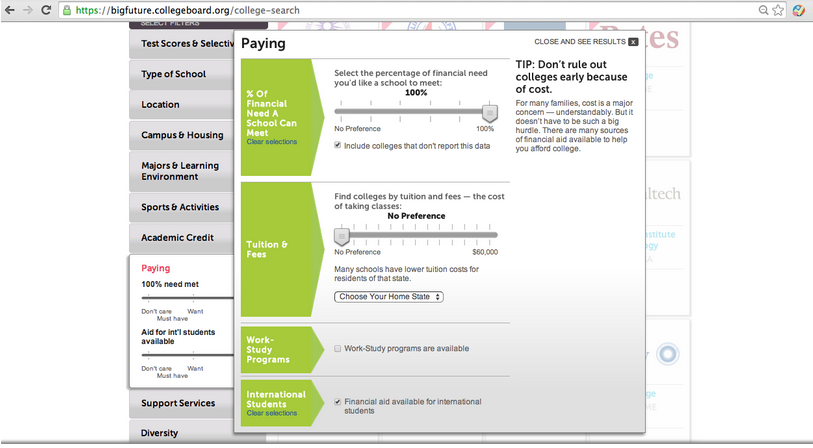
Of course not! There are many universities in the States that, albeit being need-aware, offer need-based aid and promise to meet full need upon admission. When I applied, I had the fortune of stumbling upon a website that had an almost comprehensive list of need-aware, full-need universities. Click on ‘Paying’ on the left-hand side and set the filters to “100% financial need met” and “financial aid available for international students”, voilà – some 69 universities miraculously pop up.
Screen Shot 2014-10-18 at 1.06.56 PM

There are, however, two shortcomings about this site:

  1. There is a very rigid toggle limit for the %-of-financial-need-a-school-can-meet function. The next percentage down from 100 that you can select is 80. Even schools that meet 99.9% need, only 0.1% down from full need, will be ruled out if you set the filter to 100%. I believe that universities that meet more than 98% of financial need should not be ruled out because, speaking from personal experience, there is always the possibility of appealing/negotiating for more aid upon admission.
  2. Some universities don’t report data on financial aid.

FINANCIAL AID PART TWO: APPLICATION MATERIALS

For international financial aid applicants, you typically submit the CollegeBoard CSS/ Financial Aid PROFILE or the International Student Financial Aid Application (ISFAA). Sometimes the Certificate of Finances (COF) is required along with the ISFAA. In rare cases, some universities, like Bates, Franklin & Marshall, Hamilton and Middlebury, use their own financial aid application forms for international students. In addition to your main financial aid application form, most of the time universities will also ask for certified copies of your parents’ statements of income and tax return forms.

  • CollegeBoard CSS/ Financial Aid PROFILE (Base fee of USD9 + USD16 per university)

This is an online form and the only form that allows you to fill in amounts using Malaysian Ringgit. If you are applying to universities that use a combination of PROFILE and ISFAA and/or COF, I suggest you start with PROFILE and plug in the numbers using the current exchange rate to other forms later.

  • CollegeBoard International Student Financial Aid Application and (sometimes) Certification of Finances (free of charge)

These forms come in .pdf format so you can either complete these forms with Adobe or print them out and fill them in manually. Everything in both forms should be completed in USD.

  • Statement of Income

This would generally be your parents’ monthly pay slips. If they are not in English, translate them into English and have your parents’ employers certify the copies. Companies have these in soft copies – so ask your parents to try to get the soft copies for translation purposes. It does not matter in which currency the amounts are denominated as long as the currency used has been clearly stated. There is no specific requirement as to how many monthly pay slips you should submit, but I submitted three consecutive ones for both parents.

Back when I applied some universities asked for an annual statement of income instead of monthly statements. Neither of my parents’ companies had one of those, so I printed the numbers on my parents’ company letterhead and had my parents’ employers certify them. Below is a template for this in case any of you ever need it.

To Whom It May Concern,

Verification of Annual Income and Taxes Paid in Year 201X

I hereby verify the details of my employee, XXXXXXX as followed:
a) Total Amount of Income Received in Year 201X: RM XXXXX
b) Total Taxes Paid in Year 201X:  RM XXXX

Yours faithfully,
XXXXXXX

  • Tax Return Form

For parents who work in private sectors in Malaysia, this would be the EA form. If you have to translate this form, an English version is readily available in .pdf online. Again, your parents’ employers need to certify these.


FINANCIAL AID PART THREE: MINIMIZING APPLICATION COSTS & OTHER TIPS

The financial cost of applying to American universities can add up, and it doesn’t help that we have to multiply everything by 3.20 or so. Here’s how to not break your (parents’) bank on your way to ‘Murica:

1. Have your college application fee waived (You save:USD 60-80 per school)

Have your school counselor write an application fee waiver request on your behalf, attesting to how the application fee is going to put a strain on your family’s finances. Support with evidence like your annual household income, number of dependants in your family, the total cost of application you have to pay and the current exchange rate. Alternatively, you can write it yourself and have your counselor certify it.

How to submit your college application fee waiver request:

Most colleges want you to mail it physically. However postage can be costly (not as costly as the application fee, but still.) so I asked my counselor to scan and attach the waiver request within her online recommendation letter. For schools that specify they need to receive a fee waiver request before you apply, you can always try sending them a scanned copy of the fee waiver request, explain how posting it will strain your family’s finances, ask if they can accept the scanned copy for now and promise that you will have your counselor send it online along with the rec letter.

How to submit Common App with a fee waiver:
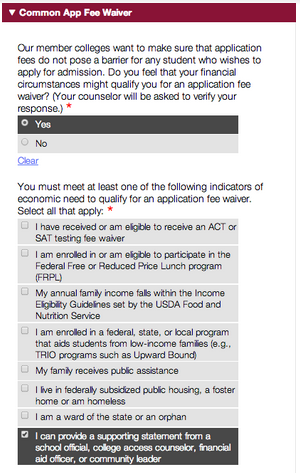
Screen Shot 2014-10-18 at 1.16.26 PM2. Have your test scores sent through counselor (You save: RM100 for IELTS per school and USD11.25 for SATs per school; not sure about TOEFL)

In order to do this, you need to write to individual schools and ask in advance, or schools will deem your application incomplete. You don’t need a formal letter like the fee waiver request; just shoot them an email stating how sending scores via CollegeBoard/ETS/IDP will strain your finances and ask if it’s possible to send them via your counselor instead.

Which score report to submit:

CollegeBoard doesn’t provide you with a physical copy of your SAT test score report unless you request and pay for it. Instead of doing this I downloaded the Online Student Score Report that is available free-of-charge to everyone who has taken the SAT and had my counselor submit the first page of both my SAT I & SAT II reports. There will be a watermark that says “NOT AN OFFICIAL SCORE REPORT” embedded somewhere highly visible on your online report, but fear not – this report will be considered official by most schools once your counselor stamp and certify it.

Where your counselor should attach your test scores:

If you have all your scores ready by the time your counselor submits the Mid-Year Report, have him/her attach them in the Mid-Year Report. Otherwise, wait till all your scores are in and have your counselor submit an Optional Report. I would suggest that you consolidate all test scores and submit them in the same report, i.e. either the Mid-Year Report or the Optional Report. Submitting them separately can be very confusing for the adcoms, and they are already doing you a favor by accepting these score reports via your counselor (this means the extra workload of entering your scores into the system manually), so be considerate!

3. Have your PROFILE fee waived (You save: Base fee of USD9 & USD16 per school)

You do this in two ways:

  • Ask for a PROFILE fee payment code by explaining your financial hardship

For reference, schools that provided me with a code were Amherst, Colorado, Cornell, Duke, Lafayette, Mount Holyoke, NYU and Skidmore. Not all schools offer a fee payment code, though. And if they don’t, go for option b.

  • Ask if they accept the ISFAA and COF in lieu of the PROFILE

Schools that I applied to had varied responses to this. Some agreed to it; some didn’t but agreed to hold off my PROFILE requirement until (if) I receive an admission offer; others sent me their own financial aid application form that they reserve for only students who cannot afford the PROFILE.

4. Have your financial documents (e.g. parents’ statements of income and tax return forms) sent electronically (You save: Whatever postage costs)


Additional Notes:

  1. The bulk of what I wrote above applies only to those with lower/mid-level household income. If you do not fall under this category and attempt to abuse these fee waivers by misrepresenting your application, know that in life what goes around ultimately comes around.
  2. When approaching the schools for waivers, be polite but persistent and assertive. You will be surprised at what you can get simply by asking.
  3. Financial aid applicants should also consider the availability of funding for unpaid summer internships and study abroad programs in a particular university before applying. This might not seem as important at the moment, but – trust me – it will be highly relevant in a year or two.

imageedit_12_5488586403

Annabelle Ooi is a neuroscience major in Mount Holyoke College. She is probably one of the few unartistic left-handers in this world who can’t draw and is tone-deaf. Feel free to email her with questions on financial aid, NeXXt scholar program, liberal arts colleges and life in an all-women’s college.

Featured

CollegeLAH’s Guide to Using Common App


Creating your CommonApp account

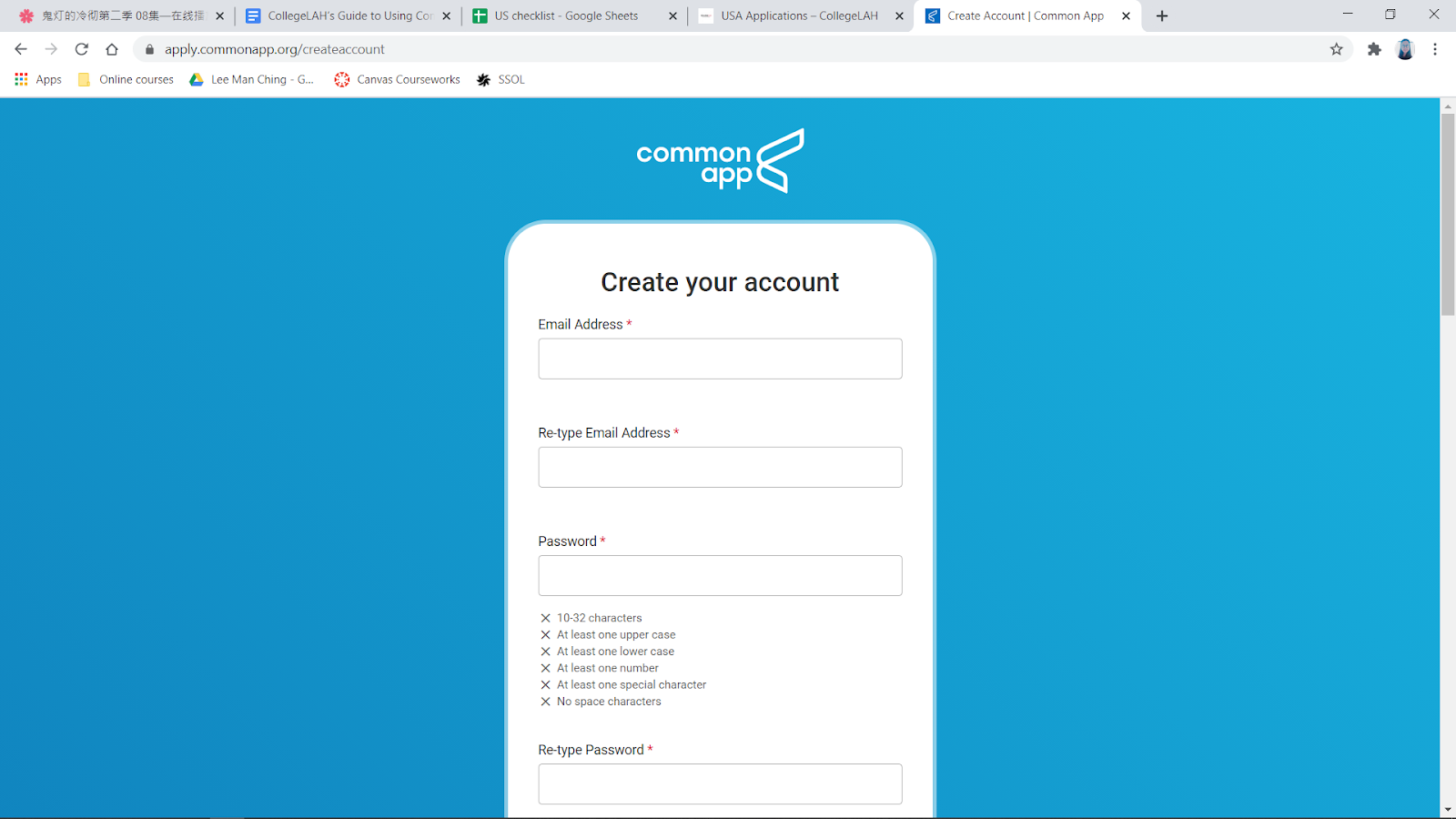
  • Go to https://apply.commonapp.org/createaccount and select “First Year Student”. This will lead you to the next page to create an account. Fill in the required questions which should be self-explanatory.

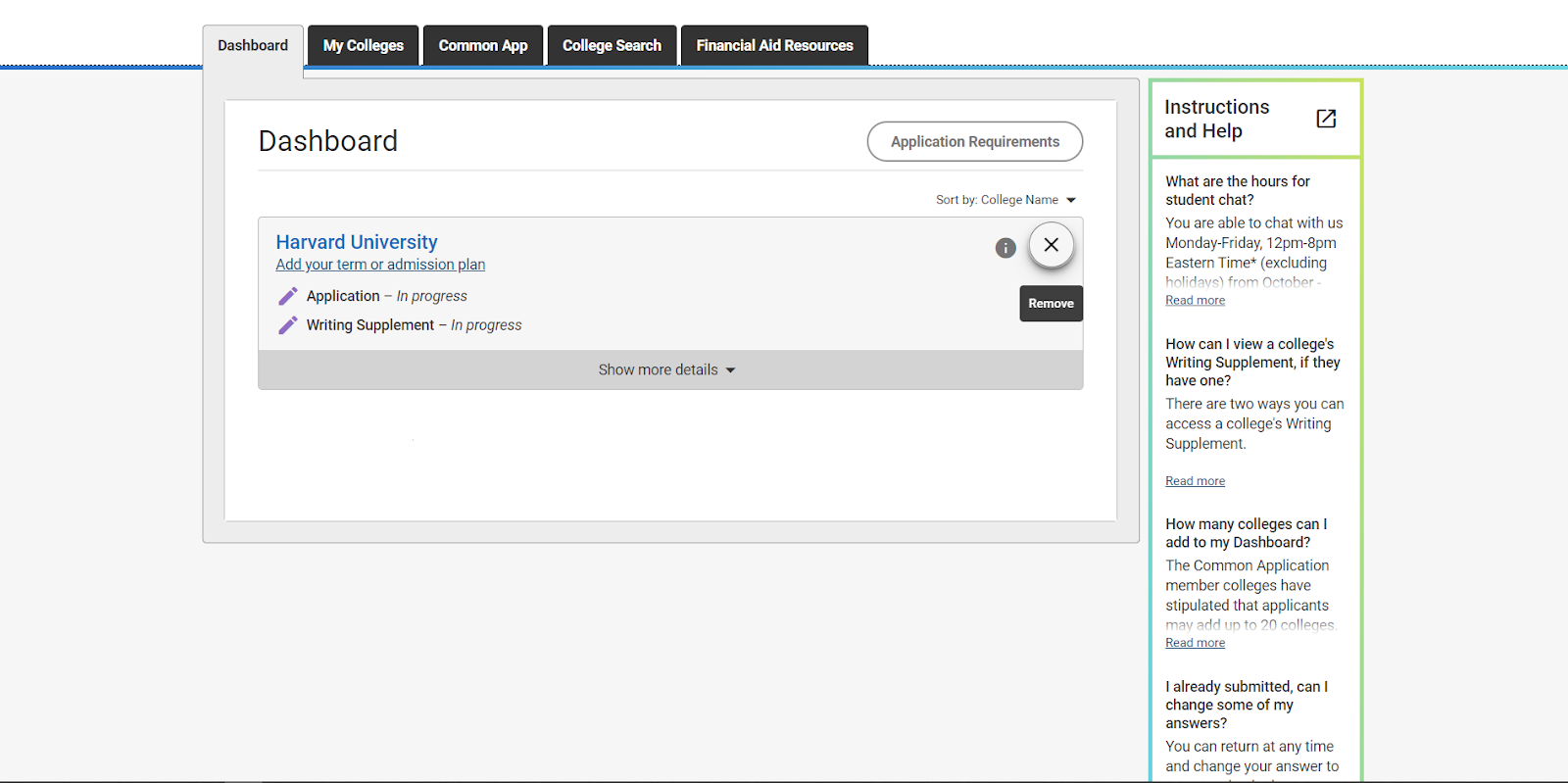
  • Once you are logged in, you are able to view your Dashboard and your full CommonApp Account.

Your CommonApp Account

  • Your CommonApp Account is separated into five functions: Dashboard, My Colleges, Common App, College Search and Financial Aid Resources.

  • Dashboard: The Dashboard is the central monitor to your applications. Once you have added colleges to your applications, you will be able to view them on the dashboard, showing you the deadlines, requirements and your progress. You may also remove the college you chose here.
  • My Colleges: The My Colleges tab shows the colleges that you have added into your account. You will complete your work for each specific college here. Some colleges will require extra essays or questionnaires answered.
  • Common App: This is where you will fill up general details which are required for every college you are planning to apply (you will only need to fill up once regardless of the number of colleges you apply), from your profile, family members’ information, educational background, standardized testing results, your high school extracurricular activities to your Common App Essay.

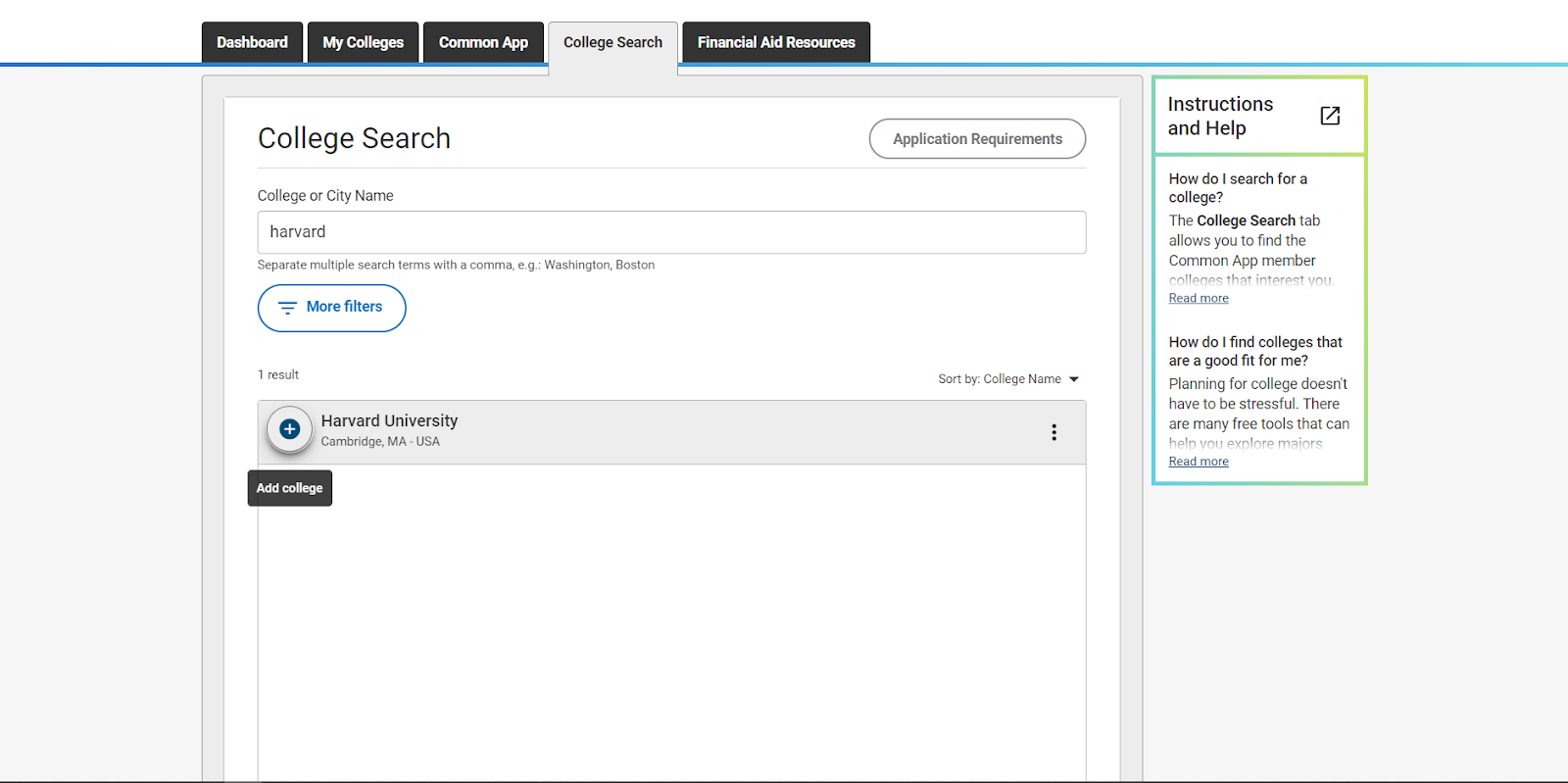
  • College Search: College Search allows you to search for colleges/universities by different criteria, i.e. by name, country, state, term, applicant type or deadline. By clicking the “add college” button, the information of the particular college will become available on your “Dashboard” and “My Colleges” where now you will be able to check out and answer the supplemental questions required by the college.

  • Financial Aid Resources: This tab provides a general guideline for the financial aid made available by the US government. It might not be applicable for most of the international applicants. For more financial aid information (ie. how to apply for college-specific financial aid), please refer to the CollegeLAH US Application Financial Aid section.

The Common Application

Profile

This is the part where you fill in everything about yourself – name, address, contact details, demographics, geography, languages, citizenship, scholarship information, and common app fee waiver. It provides the most basic understanding of who you are to the admission officers. Most of this section is very straightforward but we will clarify the bits that might not be.

Common App Fee Waiver – Nothing in this world is free. Likewise, applying via Common App costs money as well. However, if you think that you face sufficient financial difficulties such that you might be unable to afford the application fees, then you can apply for the fee waiver. Your counsellor will be contacted to provide evidence of financial difficulties so don’t try to cheat.

Family

This is also a relatively straightforward section, where you are required to fill in information about your family background. It is divided into 4 subsections: Household, Parent 1, Parent 2, and Sibling. You will need their basic information such as name, age, occupation, country of birth, education level etc.

 Education

This is where things get gradually more confusing. You will provide your educational information here, from secondary school to your Pre-U studies. Here’s a clarification that will be useful for most readers here, especially if you’re from Malaysia. Even if you are enrolled in some pre-U courses such as ADP, A-levels, IB etc. in, for example, Taylor’s College, KDU, INTI University, you are indeed still in “high school” and it will be seen as something similar to the Grade 12 and 13 under the US education system.

Hence, under the “Current or most recent secondary/high school”, enter the information of your pre-U college instead of your high school which you did your SPM, IGCSE and so forth.

Current or Most Recent School: Unless you’re studying at a school in the USA or US Territories, your school might not be listed here. Search for your school’s name and if it does not appear, select “I don’t see my high school on this list”. Likewise, if you are homeschooled, select the “I am/was homeschooled” option. 

Other School: If you are doing your pre-U education in a different institution as compared to your secondary school, you will need to fill up this subsection. Just do exactly the same as the previous step for each high school you have attended. That said, please do not key in your primary school and kindergarten. Likewise, given that high school means the schools where you did SPM/IGCSE till IBDP/A-level/STPM/Matrikulasi/AP, please do not include your PMR school if it was different from the one you did your SPM/IGCSE at. Otherwise, please do. An example of how you can provide details about why you left each of the above secondary/high schools: I left the above secondary school after I finished the Malaysian Certificate of Education (Sijil Pelajaran Malaysia/ SPM).

College & Universities: If you have completed a university level course, be it online or through a physical college, fill up this subsection. For the occasional Singaporeans who might be reading this, declare your H3 Subjects here. Likewise, if you have completed an actual uni/college level course, declare here. Please keep in mind that your Pre-University education (A-level, IBDP, STPM, Matrikulasi, AP) does not count here.

Grades: Fill in the information based on the current school you are in. If you are on a pre-U programme that does not use GPA/CGPAs (A-level, IBDP), leave the relevant sections blank. Likewise, if you’re doing Matrikulasi or STPM, declare your CGPA as well as the GPA scale (‘4’ for STPM, Matrikulasi etc.) Whether or not your GPA is weighted depends on this question – do all contributing subjects/modules/aspects have the same individual contribution to your GPA? If your answer is no, then your GPA is probably weighted.

There are 4 options under the class rank reporting, mainly
1) Exact: For instance, 53 out of 187 (187 will be filled in under “class size”)
2) Decile: Top 10%, 20%, 30% … 
3) Quintile: Top 20%, 40% .., 80%
4) Quartile: Top 25%, 50% … and so on.

Community-Based Organization: If any of these organisations helped you with your Common App application, then do declare them. These are generally non-profit organisations that are representative of particular civil societies e.g. Black communities, underprivileged suburban children. 

Current or Most Recent Year Courses: This is where you declare your Pre-University subjects as well as your Year 11 subjects (SPM, IGCSE etc). In other words, A-level History counts as one course, STPM Ekonomi counts as one course.

Honors: If you have won awards, competitions or scholarships, declare them here. Important point to note here is the grading system, Grade 9 refers to Form 4 and equivalent, Grade 10 being SPM/IGCSE while Grade 11 refers to your AS-level. Intuitively, Grade 12 is your A-level/IBDP/STPM. The exception here then is that if your pre-U course lasts only a year e.g. Australian year 12, SAM, Matrikulasi. In that case, Grade 12 refers to that and Grade 11 refers to IGCSE etc. Basically, it all depends on the number of academic years your Pre-U studies contribute to. PG generally applies to those who undertook gap years.

Future Plans: Write about your future career plans and highest degree you intend to earn here.

 
Testing

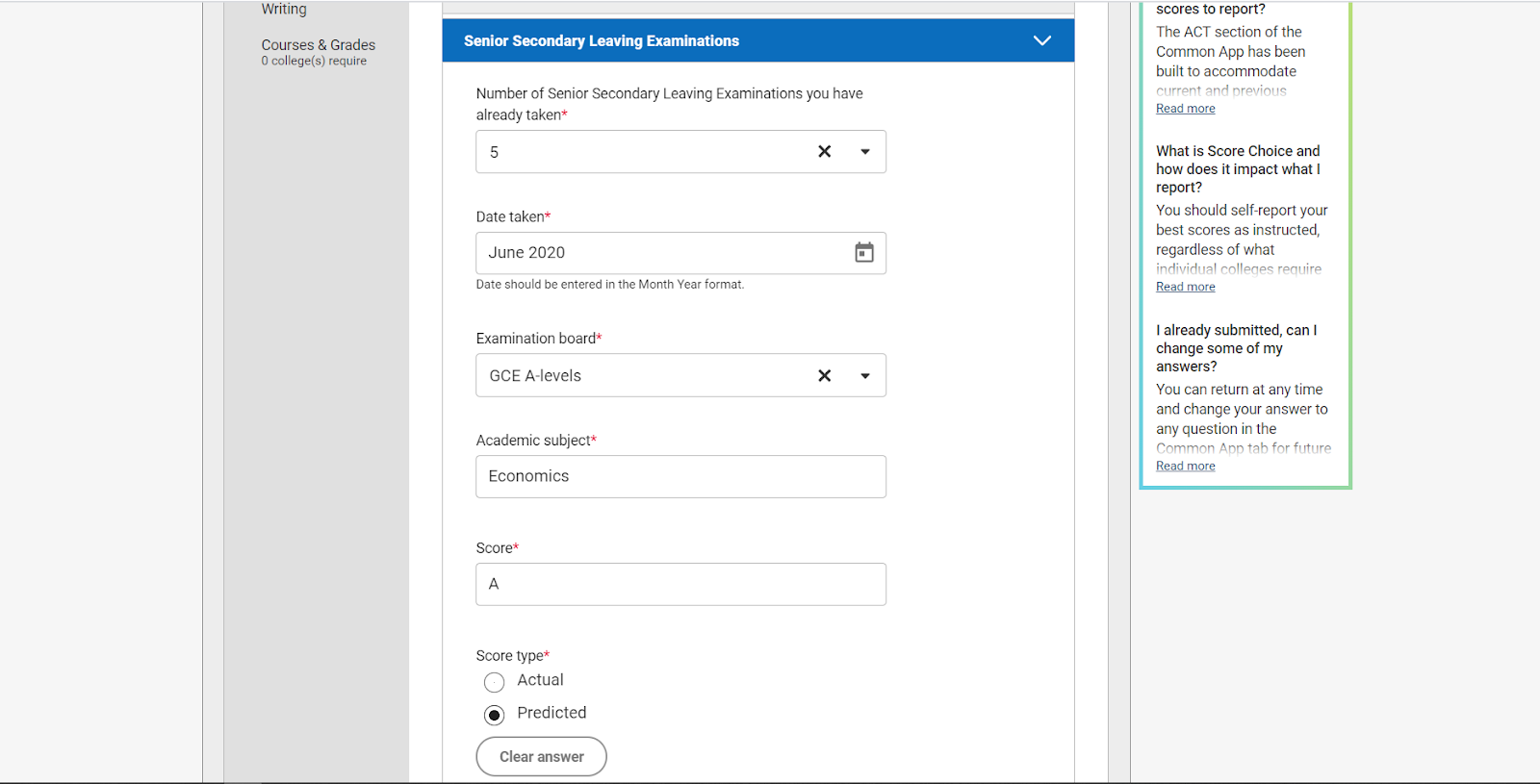
Test Taken: Check ‘yes’ to self-report your SAT, SAT II, IELTS, TOEFL, IB, A-levels scores. You should list all tests that you expect to take and have already taken. When you have chosen all the exams, they will come out as new tabs on the same page (“Testing”). Fill out the required information under each tab which should be self-explanatory.

If you have taken courses such as SPM, STPM, IGCSE, IB Middle or IBDP, elect ‘yes’ for the last column with the prompt: “Is promotion within your education system based upon standard leaving examinations by a state or national leaving examinations board?” Do note that if you took AP, you do not have to check this box.

Senior Secondary Leaving Examinations: If you check ‘yes’, a new section indicating “Senior Secondary Leaving Examinations” also comes up. For each test chosen, another column will appear; this is where you should fill in the specifics of each test. This means that if you have already sat for your A-level (including AS-level), IBDP, STPM, then tick “yes” and fill up accordingly. For most, who are still studying for the actual examinations, tick “no”.

 
Activities

After indicating ‘yes’, you have a maximum of 10 columns for you to fill in all activities. You’re given a maximum of 50 characters to state the name of the activity, and another 150 characters to describe the activity. Once again, please take note of the grade level system (may refer to the “Honors” section). If you are taking a gap year after your Pre-University studies, any activities done after graduation come under “Post-Graduate”. 

For sports specifically, if you are in your school/state/national team, then you are involved in “Varsity/JV”. If you are not in the main team i.e. recreational, secondary or development team, then you are in “Clubs”. Please also take note you are required to list the activities in accordance to their significance to you.

For example:

Music Club – Founding President

Spearheaded 2 national music concerts; raised $10,000+ for the Malaysian Elderly Association. Honed leadership skills working with 60 members.  (142 characters)

Keep your description concise to minimize character count and convey your message clearly. You might want to consider carefully which activities to include as this section is vital in portraying who you are both as a student and as a person. It is highly recommended that you state activities that you are interested in continuing in university. You may include your experience in internships or volunteering or even hobbies if you feel that you have gained a lot from these activities.


Writing

Personal Essay

You have a choice of 7 prompts to choose from. Choose one from the list below:

Our advice would be to briefly write down the main outline of your response to each question. With this in mind, you can roughly compare the quality of your responses across all questions. Try not to overthink the process; choose the essay that gives you the right platform to best express yourself. Ultimately, this is where you have the opportunity to showcase your unique identity and personality.

Please also find https://collegelah.com/2014/08/07/how-to-write-successful-us-college-application-essays/ here some more detailed tips on writing US college application essays.


Disciplinary History

Honesty is the best policy! Do not be afraid if you have a tainted disciplinary record. This does not mean that you will be rejected solely based on this.

 Additional Information

It is not necessarily the case that your application would be in any way disadvantaged if this section is left unfilled. If there is nothing else to add, there is no need to include unnecessary details.

However, if you do wish to include additional information, here are examples of what could be added:

1) Description of the 11th extremely important activity (because you can only write about 10 activities in the previous section)

2) Clarification of extenuating circumstances –

“Took a gap year after Year 11 because …”

“SAT scores were unusually poor because…”

“Discontinued a music syllabus after Year 10 because…”

3) Information regarding yourself that you think the application will not be complete without. However, please do not continue your unfinished essay here.

That is pretty much the information you need to know in order to complete the Common App. Congratulations on completing this CommonApp section! The specific questions under each college tab should also be straightforward to you. As for the supplemental essays, don’t freak out! CollegeLAH essays editing services are here to help you!

Some extra tips: 

Recommenders

Under the tab of every college that you have added to the “My College”, there will be a subsection called “Recommendations and FERPA”. This is where you invite your teachers to be your counsellor and recommenders. You will need to go to each college tab to invite them manually and some basic information about your teachers here such as their full names, phone numbers, emails etc.

Normally, students will invite 1 counsellor together with 2 (or 3, although less likely) recommenders. If you’re studying in an American-styled school, you should have a designated school counsellor. Otherwise, this can be any teacher or academic staff member who has good knowledge and understanding of the non-academic aspects of you. Therefore, it is entirely up to you whether you want a teacher from your secondary school or one from your pre-U school to be your counsellor. Common App references are significantly different from what usual Malaysian references would be, so be sure that your counsellor knows about the writing style.

As for teacher recommendations, it is advisable to invite one teacher from a science subject and the other one from a humanities subject to showcase a broader picture of your overall performance in school. Likewise, you can also have non-academic referees e.g. sports coach, music tutor (more relevant for those applying for sports/music scholarships). Similarly,it is entirely up to you whether you want a teacher from your secondary school or one from your pre-U school to write your teacher recommendations.

Waiving your FERPA rights means that you agree legally not to have access to your references or transcripts and have your counsellor send them on your behalf. Please note that once your recommender is invited into your application for a particular university, his/her reference can also be used for all other universities you are applying.

Featured

Bank Negara Kijang Scholarship

Bank-Negara-Malaysia

What is the Kijang Scholarship?

The Kijang Scholarship is one of the two overseas scholarships offered by Bank Negara Malaysia (BNM) (also known as the Central Bank of Malaysia) aimed towards SPM graduates, making it one of the many generous institutions that offer scholarships at this level. Applicants are able to request to be sponsored to study at the UK, USA or Australia at university level to read one of a certain few disciplines – Economics, Actuarial Science, Law, Accounting & Finance and Mathematics. These specific subjects are chosen because BNM is a Central Bank, thereby requiring its human capital to be proficient in these fields in order to regulate the economy effectively.

What is the difference between Kijang and Kijang Emas?

While this article will be on the Kijang Scholarship predominantly, some obvious differences between Kijang Emas and Kijang will be made clear here. In terms of grade requirements, Kijang Emas is exclusively for straight A+ students while 8A/A+ is the requirement for Kijang. The difference in criterion stems from the terms of the scholarships themselves. While the Kijang Scholarship limits itself to the 3 countries and 5 disciplines mentioned earlier, Kijang Emas permits its holders to pursue any discipline in any country. However, applying to Kijang Emas doesn’t guarantee you assessment for the Kijang Emas; if BNM thinks that your application is more suitable for Kijang, you may be shifted. In contrast, I have never heard of the opposite happening thus far.

Is there a bond that comes with the scholarship?

There is a service bond for holders of the Kijang Scholarship – 2 years of work with BNM for every year of sponsorship. This means that getting sponsored for 2 years of A-level plus 3 years in the UK means 10 years of bond. The plus point is that you get job security in a Central Bank. This is, I believe, explicitly stated in the BNM scholarship webpage. In comparison to other scholarship bodies in the financial or governance sector e.g. Maybank, Sime Darby and JPA which all have bonds of between 4-5 years, Kijang Holders have to serve a far longer bond period. Kijang Emas scholarship recipients, however, are not bonded to BNM, though they are called to contribute to Malaysia, also for double the period of the sponsorship.

How is the assessment process?

There are two major stages in which your suitability for the scholarship is assessed.

The first, of course, is the online application. Right when SPM results are released i.e. early March, the BNM website will commence its scholarship applications, of which links can be found on their website. It is imperative that you do not apply to the wrong scholarship given that there are scholarships for undergraduate level and beyond as well, in which you may have proven your lack of competence if you do so. The online application is relatively simple: just key in whichever details they ask for e.g. personal details, SPM grades, co-curricular achievements etc. I have heard that applicants have to write short timed essay at this stage (I did not have to in 2013, but heard that 2014 applicants had to). Whether it is true or not, if you truly know what you want to apply for and why, plus if you are a competent student, you will fare well.

Your co-curricular achievements will definitely help in making you stand out from the myriad of applicants, all of whom have stellar grades. Perhaps by coincidence, but a significant portion of people that make the cut all the way until the end and eventually attain the scholarship itself, are debaters. A more intuitive observation was that people who get shortlisted have at least national-level achievements. I, for one, had an international-level achievement, about two national-level achievements, amidst several state and district-level achievements plus 8A+, 1A in SPM. It is imperative that you excel in co-curricular activities while in secondary school rather than going full bookworm. If you haven’t, you are probably not going to make it, unless your application seems strong even without it.

If you are one of the lucky ones amidst a huge pool of competent applicants all across Malaysia, your second stage would be the 3 day 2 night Kijang Academy which will be held at Lanai Kijang and Sasana Kijang. I have no way of assuring that this will be the length of the Academy at the time this article is read. It is usually at this stage where people realise how sophisticated the Central Bank can be. You will be staying at Lanai Kijang, their residential building while a majority of your assessment will be in Sasana Kijang, the futurist glass building equipped with cutting edge technological gadgets and a huge library. There will be good food for the famished.

So what is this Kijang Academy?

If you have hundreds of equally competent applicants on paper, how do you choose a handful of scholars? The solution would be the usual – interviews, group tasks etc. This is where Kijang Academy occurs. However, the Kijang Academy is designed in such a way that it is impossible to fake it through. Who and what qualities they are looking for are never known explicitly. So my advice at this stage for you prospective applicants would be to be yourself at your best and be a humble person.

Stage 1

The first stage during my year was an essay on the first night of our stay. Questions were generally personal i.e. your qualities, studying attitudes etc. My inference was that this task aims at showcasing your thought process, reasoning, structure and effective communication. It is imperative that one writes concisely; verbosity hinders communication. They want to know more about you rather than to see you show off your flowery, bombastic and glorious language mastery.

For my case, it was done in a relatively short period of time (not exactly short if you reflect on it after a year of A level) in a ballroom sort of hall.

Stage 2

The second stage begins on the following day in Sasana Kijang. Do note that this may be drastically different by the time you are reading this article as scholarship assessment methods change over time at their discretion. This stage consists of several group-based assessments – interviews and tasks. You will be put into groups of approximately 10.

The first portion of the group stage was intuitively an ice-breaking session. I was required to introduce another member of the group while she did the same for me. The setting was designed to make everyone less stressful or tense and know each other more for the remaining of the group stages. So for strategic purposes, get to know everyone in your group well; perhaps knowing their strengths will do.

The second portion of the group stage, if my memory doesn’t fail me or if nothing changes, was an interview done under the disguise of a series of role-play tasks. We were supposed to give talk shows presuming that we are experts of our desired fields of studies. By desired, I mean the disciplines you applied through the system. Essentially, it means that they want to know even more about why you applied for your desired subject of choice under a less pressured situation.

The third portion of the group stage was a obligatory group task as per what other scholarship bodies also do – a group presentation based on a business problem i.e. to come up with a solution for a situation portrayed within 30 minutes of discussion/preparation within your group. The presentation would last approximately 10-15 minutes in extension to Q&A by the assessors. Fret not about your knowledge in business jargons as the questions are designed to be fair to everyone regardless of pre-existing knowledge on business. It aims at exposing how you function as part of a team. Keep in mind that this is not a game for dominance by anyone; your purpose is to contribute towards a working solution as a team. If you, in any way, decide that being “shiok sendiri”, shutting out others or being a dictatorial leader is a good way of working as a team, all the best!

The fourth and final portion of the group stage was a creative group work, in which most will find this part the most memorable, enjoyable and stress-free. You will be using limited resources e.g. limited amount of papers, tapes and sticks to build something within an hour. We were tasked with building a tower. Creativity counts here as well; hence, artistic members of the group will be of great use here. With the creativity cap removed, my group produced a futurist twin tower ultrapolis. My advice for this part is the same as the previous paragraph: you are part of a team striving for a creative solution, so do your part and contribute effectively.

The Break Announcement

At the beginning of the Kijang Academy up until now, there will be about a hundred of applicants per batch. Intuitively, they are not going to interview everyone personally if they can cut down some by this stage, which is exactly what happens. The assessors will be able to identify who may secure the scholarship and who definitely won’t by the end of the group assessments. Only those who may secure the scholarship by the judgment of the second stage stay onto the next stage – the individual interview and presentation. The announcement is done differently in my year than in the following year. However, the main characteristics stay – a list of students will be announced and be told elsewhere that they have been dropped out of the selection process. Either that or those who make the break will be told elsewhere.

Stage 3

The final stage of assessment consists of two parts – the individual presentation and the interview. By this stage, approximately half of the applicants would have been dropped out, leaving every group with on average 4-6 members. There doesn’t seem to be any quotas of participants making it to this stage as some teams have significantly more or less members at this stage.

The first portion of the final stage begins such that you are given 15 minutes to prepare a presentation based on one of the questions from a list. There are general questions similar to SPM-level questions and more external knowledge-based questions. Most interviewees went for the general questions. Do note that while all of the applicants prepare together, not everyone gets interviewed immediately after. This does not mean that you are allowed to make edits after 15 minutes of preparation to your flipchart. When it is your turn, you will be asked to present whatever you have for about 10 minutes plus 5 minutes of Q&A session by the assessors. Effective communication, reasoning and making sense is still the key here.

The second and ultimate portion is of course the interview itself, which may be rather lengthy. Mine, for one, lasted almost about an hour. In practice, your interviewers want to know more about what they have learned about you in the previous stages e.g. why your chosen course, why Bank Negara and of course, showcasing through your ECAs/school life why you are suitable for the scholarship or even working in Bank Negara as a whole. Essentially, they want to be sure that you are suitable for the scholarship. There is no point awarding a scholarship to a student who won’t fit into working at Bank Negara. The criteria of assessment remain difficult to decipher, my advice remains the same – be yourself at your best.

What happens after Kijang Academy?

This is arguably even more stressful than the assessment itself if you make it thus far. You have to wait for almost 3-4 weeks before you get the decision from BNM. There is only so much you can do at this stage, go on with interviews from other scholarship bodies, continue college education or get on with life as usual. If you are awarded the scholarship, you will receive a phone call from BNM telling you the discipline you are sponsored to pursue; you will also be told of the country in which your undergraduate studies will take place, hopefully. There are people who do not attain their first choice, presumably that the assessors think that their second choice suits them more. By words, you can decide to either accept or reject the scholarship through phone.

There will be a day dedicated to briefing you and your parents about the scholarship terms and preparatory colleges (KTJ, KYUEM or Taylor’s), probably about a week after you get the call from BNM. On this day, you will be briefed on the scholarship contract just like how legal firms and banks normally would.   Make sure that you get as much clarifications as you can on the terms; your following 1 or 2 years in the prep colleges will be directly affected by them. After which KTJ, KYUEM and Taylor’s will brief you on their schools/colleges.

What to do after being awarded the scholarship?

If you are awarded the scholarship, it means you have attained a privilege to have free overseas education, arguably a dream everyone would have. Don’t let it go to waste. Keep in mind that attaining the scholarship is just a stage but retaining the scholarship is another. The universities which you are allowed to apply to are extremely competitive ones, which is rather intuitive because who would want to sponsor stellar students to average overseas universities on par with local universities. This means that you will have to study even harder to get your places in the overseas universities. In your preparatory colleges/schools, life will be even more hectic than in secondary school with more academic content and co-curricular activities. My ultimate advice would be to prioritise smartly; the Bank sent you to whichever place you end up in to study, not to flunk your grades because of anything.


imageedit_4_4122498761Suah Jing Lian is currently a Bank Negara Malaysia Kijang Scholar who’s pursuing his A-level at Kolej Tuanku Ja’afar and hopefully Economics in the UK. He has a penchant for Baroque music, particularly Bach’s partitas, and debating, which he claims provides sparks to his life. People claim that he looks and speaks in an intimidating way but not really, he’s one of the most eccentric people you will ever meet.


Featured

Biomedical Science Personal Statement

This Personal Statement was part of this student’s sucessful application to study Biology in Imperial College London, Natural Sciences in University College London and Durham University as well as Genetics in University of Edinburgh.


What happens if chloroplasts are injected into your bloodstream? How can a human breathe underwater? What happens if you jump into a hole drilled through the earth’s core? These are some of the intriguing questions asked by my younger brother. These are not questions which answers can be found in textbooks so I have to rely on logical reasoning to answer him. Of course, these questions are impractical in reality but I enjoy trying to solve the unsolvable. After a period of intense questioning, I myself developed this peculiar habit of asking why and what. I consider this to be my greatest strength because it allows me to look at science from a different perspective. History shows us that the biggest discoveries are not those with the biggest answers but those with the biggest questions.

Most people will define science by its three main subjects; biology, chemistry and physics. However, my view of science is that there are no rigid boundaries separating the subjects. Learning only one of the subjects is inadequate because those subjects are related in a thousand and one ways. For instance, the chemical composition of purines and pyrimidines is what allows the precise replication of DNA. Even mathematics can be found reappearing in nature as the Golden Ratio. Throughout my studies, it has always been a thrill to be able to apply concepts I learnt from one subject in another. Not only does this enable me to understand the subjects better, it gives me an immense satisfaction of being able to connect them; like same-coloured tiles of a Rubik’s cube coming together.

My particular interest in biology has leaded me to do a hospital attachment. I witnessed a gastroscopy and a biopsy being done to test for H. pylori. One branch of biology which intrigues me more than the others is genetics. Genetics is more than just the study of genes; it explains how one’s phenotype arises from the complex relationship of its genotype with its environment. The idea of nurture vs. nature and which has the upper hand in determining an organism’s characteristics appeals to me. Darwinism and Mendelism complement each other so beautifully and the unification of both theories is something I want to learn to greater detail. Genetics immediately caught my attention when my high-school teacher taught us about DNA replication and transcription. The way free nucleotides which have no sense of order at first, could suddenly line up next to the exposed DNA strands in a precise arrangement is simply elegant; order from chaos. When I read The Violinist’s Thumb by Sam Kean, I stumbled upon transposons. Further research left me in awe because these “jumping genes” further prove that something as inanimate as DNA could do as much as something living, if not more. The way transposons work raises many questions, so I am eager to learn more about it at a higher level. I even requested for an interview with a local geneticist to find out more but I am still waiting for a reply.

During my schooling years, I consistently top my batch in exams and was awarded with numerous top-in-subject awards especially in maths and science subjects. I was also named the Top 50 Best Scorer in Malaysia for the Malaysian Certificate of Education (SPM). I took part in many maths and science competitions to try a different approach in learning these subjects. As a result, I found out that I enjoy the challenges set by the competitions and gained a lot from them. An example of my achievements is I was awarded a High Distinction in the National Malaysian Chemistry Quiz. I also emerged second for the KDU’s Maths and Science Competition. Badminton and squash is my forte and I took part in tournaments. Debating was also a passion of mine in secondary school and it had taught me to think critically and analytically, which are important assets in the science field. I gained leadership experience by being the Assistant Head Prefect and I was also the Vice Captain for my school’s Blue House.


DISCLAIMER: The personal statements on this site are strictly meant as a starting point to give an idea of how successful personal statements look like. There is no surefire formula to writing good personal statements. COLLEGELAH IS STRICTLY AGAINST PLAGIARISM OF ANY KIND. UCAS employs a plagiarism check system that checks applicants’ work against other published writing so please DO NOT PLAGIARISE.

Featured

Penangite Guide to Studying Medicine at Cambridge

2011-09-22-09-32-52-2-up-to-half-of-uk-cambridge-graduates-work-as-gener

Image Source

Tell us a little bit about yourself.

Hello there, my name is Ming and I’m from Penang. I studied at The International School of Penang (Uplands) for my entire secondary school, ending with the International Baccalaureate for my sixth form studies. The next step is Cambridge, where I’ll read Medicine and graduate in 2020. I haven’t ever been under a scholarship and won’t be under one at Cambridge as far as I know.

What was included in the application process to your university?

Well, like any other applicant to the UK, I had to go through UCAS, which means a predicted grade from the school, a personal statement of 4,000 characters and a boatload of information they requested. Then as a medical applicant, I had to sit for the UKCAT, an aptitude test for admissions to most medical schools in the UK. On top of that, as a Cambridge medical applicant, I had to sit for the BMAT, which (as far as I know) is an aptitude test only for medical admissions to Imperial, UCL and Oxbridge in the UK.

I had the option of writing additional essays for Cambridge on COPA, which is the application portal for Cambridge (basically doing UCAS a second time). I chose not to write additional essays because I knew I wouldn’t be able to write something of good quality within the short time I had.

How did you write your personal statement?

The personal statement has been described to me (by an applicant to the USA, might I add) as “mechanical” and “formulaic” although it is meant to be unique and personal, as its title suggests. Perhaps applicants to both the USA and UK may think that because they write touchy feely essays for Commonapp about how their life was shaped and all. In my opinion, you do need some structure to your personal statement, but you also need to make sure it doesn’t sound computer generated. I chose to include why I want to do Medicine, how I’ve shown to have passion for it and the skills required for it (and thus elaborating on my extra-curricular activities), and how my previous experiences in the field have affected me.

Did you perform any attachment before applying?

Attachments and internships are important not just for your CV and application, but to find out if you actually like what you think you’re interested in. I (rather obviously) chose to do a few attachments at a hospital, watching surgeries, shadowing consultants, observing in Accident and Emergency etc. I found that I didn’t particularly like surgery and that I’m rather interested in oncology, which I think was useful for me. If I could go back a few years, I would also do some care work, like volunteering at a home for the aged, as such things are quite common for medical applicants and are useful to talk about at interviews.

What ECAs did you participate in?

Leadership and organisation is something all universities and subjects appreciate. You want to be able to stand out in a crowd of thousands. I’d say stick to your strengths, wherever they may lie, and be the best at whatever it is. Don’t force yourself to do something you don’t like because you want a nicer CV. You might hate it, and you might not do as well. For me, notable ECAs included music (orchestra), sports (basketball and badminton), leadership (Student Council), charity (founding a volunteer/charity organisation in my school), public speaking (Model United Nations), organisation (Student Council committee, organising an MUN conference, organising events for the charity organisation). So there you see I did things I like, and thus had the passion to excel at each.

How did you prepare for your admission tests?

I sat for the BMAT and UKCAT. Aptitude tests are generally difficult for me because my thought process is rather slow and my reading is yet slower. My tip is to just do lots and lots and lots of practice. A week before my UKCAT, I realised I was on track to get 50% (poor is an understatement), and so I put everything on hold and just did UKCAT for that entire week and ended up in the 98th percentile – I suppose it paid off. Don’t stress yourself out like that, learn strategies and do lots of practice early, using the ton of books available out there.

How were the medicine interview sessions?

I had three interviews in total, one for Cambridge, one for King’s College London and one for Southampton University. King’s and Southampton gave me very standard medical school interviews, asking questions such as “why do you want to be a doctor?” and “why not be a nurse or someone else in the medical profession?” At King’s, there was one interview; at Southampton, there was one group interview and one individual interview; and for Cambridge, I was interviewed in Malaysia and thus had one individual interview.

In each case, I tried to make the interview a discussion, which didn’t work at Southampton, but worked to an extent with Cambridge and King’s. This made things a lot less awkward and tense as I was much more able to connect with my interviewers. Most of them were friendly except those I encountered at Southampton, perhaps because they were medical practitioners while the rest were academics.

To prepare, I read up on medical news, be it advancements or ethical case studies (which are quite important). I also practiced some interview questions in a mirror to take note of my facial expressions and how to change them to reflect more positively on myself. I don’t think the latter helped me very much though.

What do you think contributed to the success of your application?

I believe universities look for individuals who add to and improve the standing of their schools. As such, you should look into the course you are applying to and the university you are applying to in order to know what sort of people they are looking for. In my case, it was a well-rounded, passionate and compassionate communicator and scientist, and so I included experiences and achievements that (I felt) showed/helped develop these qualities. I essentially moulded all the activities mentioned above to fit these and included the more significant and recognised ones.

What advice would you give to future applicants?

START EARLY! I think that’s the most important thing. Resources will be different for everyone, so starting early will give you the time to look up all the things you need to be the best applicant possible. If you’re stuck, look to forum sites like ‘The Student Room’ as you are almost definitely not alone in your struggles. Good luck!


imageedit_12_8589795891Lai Ming Yi is a Penangite heading to the University of Cambridge to read Medicine. He is interested in leadership, management and all things frisbee, and can be frequently found in hawker centers on the streets of Penang.

Featured

Of Robes and Long Dining Tables, of Fireplaces and Scholars.

CI-in-the-sun

Image Source

Besides being THE most prestigious university in the world, Cambridge has been my dream. A dream that never was. I mean, me? Surely, there must be more qualified candidates around the world.

So there I was, scrolling through Cambridge’s entry requirements after receiving my AS Level results. Imagine my joy when I found that I met the minimum entry requirements. But that was only the first step of a long and arduous journey.

Personal Statement

THE personal statement. Quite possibly the most formidable step of the UCAS application. (Interviews aside, of course.) What on earth do you write? How do you get someone to take notice? Well, it might be a good idea to grab hold of some successful samples online, just to have a brief idea of what to include. Generally, the outline would be: catchy introduction and why you chose your subject; what you’ve done that demonstrates your passion towards the subject; your extracurricular involvements and the type of skills they inculcate. But of course, you already know the drill.

  • I like Physics/Chemistry/Biology. No, no, no. Be a little bit more subtle.
  • If you’re going to start your personal statement with some cliched quote from Darwin, Stephen Hawking or Albert Einstein, forget it. At least use a slightly obscure quote that no one else ever uses. It might pass you off as slightly more intelligent than the other candidates.
  • If you’re going to mention the New Scientist or Cosmos magazine, please be a little more original. At least every other (if not all) Natural Sciences personal statement includes a mention of those articles.
  • If you have no idea what to write, grabbing a few books off the suggested reading list or watching public lectures related to your subject might be good starting points.
  • Demonstrating how the activities you’ve partaken in qualifies you for a Science degree undoubtedly requires some creativity. Being a club member improves your team-working skills, and that will help when you’re in a research team, for example. Well, if you’re involved in a remotely interesting club (like Geography), that would hone your patience, which is ABSOLUTELY essential when carrying out experiments.
  • But do try getting yourself involved in international science competitions, volunteering for science fairs, attending public lectures and writing about them in your personal statement subsequently. They would vastly increase your chances of getting noticed.

Interviews (Or not)

Next go hours, days and months sitting before the computer screen, waiting for that all-important email. Certain colleges require that you send in copies of your written work prior to your interview (essays, assignments etc.). But don’t worry if you don’t have any – just send them an email to explain. I didn’t have any either.

As the interview would likely be centred on your personal statement and whatever else you wrote on your COPA, it would be helpful if you familiarize yourself with whatever you wrote. Say, if you wrote that you like evolution, read a few books about it so that you are ready for whatever the interviewer throws at you. They’ll probe you just to check that you actually know what you wrote about, but that’s about it. The other questions will likely be about A level topics, specifically, the modules you wrote about in your COPA.

There will also inevitably be a section on drawing graphs, so just be prepared to draw a graph for a given equation and explain why it should be like this or that, etc. Oh, while I’m at it, just think aloud. It’s good entertainment for the interviewer as he/she tries to figure out your thought process and deliberate on whether you’re teachable. My interviewer was actually trying to teach me about proteins during the interview session. There will also be paper and pencil laid before you, so feel free to use them if you need to illustrate your thoughts.

The good thing about Cambridge interviews is that you don’t need to smile and put on a whole bubbly, cheerful personality. Just be yourself (in the truest sense of the word). One interviewer once said that what distinguishes offer-holders from non-offer-holders is the sparkle in their eye. Be really passionate and treat the interview as a tutorial session.

If you were having your interviews in Malaysia, there will be a TSA assessment followed by an essay question a few days after the interview session. It would be worth going through “Thinking Skills” by John Butterworth and AS Level Thinking Skills past papers. As for the essays, they would likely be on stuff that you have learnt during your A levels. You might find some sample questions on college websites (I think Magdalene College has it).

That’s about it for applying, I guess. Good luck and may you achieve your dreams!


This student will be pursuing Biology in University of Cambridge, although she has also received an offer from Imperial College London. The aforementioned student has chosen to remain anonymous for fear of invoking the anger of Geography students.

Accounting and Finance Personal Statement (Zakii Kenali)

This personal statement was part of this student’s successful application in Accounting and Finance to London School of Economics, University of Warwick, University of Edinburgh, Kings College London, University of Manchester.


My mother’s persistent mantra ,”Never get into stocks” has been a constant refrain since I first showed an interest in investing. She witnessed my late grandfather, a retired school teacher, lose his life savings when he was persuaded by a remisier to take up an overdraft to leverage on margin financing. He never understood the essence of the deal as he was just a teacher, trusting the remisier enormously with all his money, and eventually brought about a heavy debt burden when the 1997 Asian Financial Crisis struck in addition to the losses. This presented to me the core significance of financial literacy and intricacy in adults of all ages, prompting me to explore the complexities of Accounting and Finance.

Studying The Private Equity Playbook by Adam Coffey familiarised me with the highly unregulated and growing market of Private Equity(PE) that controls a substantial proportion of global businesses. I noted from the book that PE firms heavily rely on Leveraged Buyouts(LBOs) and harsh cost-cutting measures to optimise profits, usually at the expense of employees, primarily for short-term gains. According to a paper by NYU Stern, companies embroiled in LBOs are 10% more likely to experience significant workforce reductions within three years while the chances of bankruptcy post-acquisition increased by nearly tenfold. It dawned upon me that the repercussions of LBOs, driven by an aggressive pursuit of profit maximisation, often disproportionately affect the livelihoods of employees and the long-term health of the business.

Yet, while the immediate outcomes paint a grim picture, I realised it would be remiss to draw conclusions solely from a consumer perspective. A session I had with the founder of a leading PE firm in Malaysia gave me an alternate view. He quoted that the success of PE investments should be valued in the long run, not just based on the initial impact. Through research, I found the acquisition of Burger King by 3G Capital to be a prime example. Despite the initial layoffs needed to stabilise the struggling brand, the long term proved to be transformative as the company expanded across regions, creating many more jobs than it had initially let go. My passion in navigating financial complexities and assessing the broader impact of business decisions makes me eager to study it at university.

The 2020 PwC accounting and consulting scandal really shed light into the perfidious work that the firm has been doing for years. PwC were found to leak confidential tax plans that they helped write into law to their corporate clients, allowing their clients to find loopholes in the tax system, essentially to enrich their clients and themselves. This led me to read Ian D. Gow and Stuart Kells’, “The Big Four: The Curious Past and Perilous Future of the Global Accounting Monopoly”, which gave me insight on the dilemmas in ensuring that these firms abide by the laws, particularly the influence that they have in global politics and legislation. Witnessing how small fines or settlements become merely “the cost of doing business” and failing to deter fraudulent activities made me realise the urgent need for more robust regulations and cultural reform. As President of Financial Literacy Club, I organised a case study investment competition with emphasis on corporate ethics and accountability, ensuring that I play my part in preventing future corporate malfeasances and unethical practices.

In the same capacity in the Financial Literacy Club, organising an educational trip to PwC Malaysia exposed me to the industry, learning the inner workings of the firm through the lens of its professionals. Moreover, executing the event required organisational synergy to liaise between various groups concurrently.

I aspire to provide innovative solutions and drive ethical change in the field, upholding my values closely. At university, I seek to maximise my intellectual potential, yearning for a world-class education to excel in the future.


DISCLAIMER: The personal statements on this site are strictly meant as a starting point to give an idea of how successful personal statements look like. There is no surefire formula to writing good personal statements. COLLEGELAH IS STRICTLY AGAINST PLAGIARISM OF ANY KINDUCAS employs a plagiarism check system that checks applicants’ work against other published writing so please DO NOT PLAGIARISE.

Mathematics and Statistics Personal Statement (Amy Ekeh)

This personal statement was part of this student’s successful application in Mathematics and Statistics to LSE, UCL, Queen Mary University of London, Birmingham University.


Uncertainty governs every decision I make. My interest in mathematics and statistics stems from a desire to rationalise this uncertainty, by using numerical methods such as probability, to quantify risk. This has proven vital to my understanding of A Level economics, where the use of calculus in price elasticity has provided insight into consumer rationale. Studying key economic phenomena such as inflation, has allowed me to contextualise statistical models widely used to explain the state of our economy. I have become engrossed in combining these fundamental disciplines, in order to understand real life problems.

An area of mathematics that interests me most are proofs. Combining different areas of mathematics to derive one coherent line of work is greatly satisfying. B.Clegg’s ‘A Brief History of Infinity’ contrasted my initial outlook on mathematics being based solely on objective truths. He compares a mathematician’s use of infinity to our use of a mobile phone, as we acknowledge its functionality without fully knowing how it works. The underlying ambiguity of more complex mathematical phenomena has prompted my curiosity to study more difficult mathematical concepts at university level.

Logical and empirical reasoning that form the basis of mathematics is reciprocated in economics. Comparable to applying a formula to a maths question, deriving economic solutions to a problem using different policies is a process I find intriguing. However, I haven’t found the simplicity of said ‘maths formula approach’ equally applicable to non-western economic issues, particularly in Nigeria. Viewing Nigeria through the lens of my father, who had fallen victim to indigence during the Biafran war, I perceived Nigeria’s current economy as a product of conflict and political unrest. This was juxtaposed by several articles about Nigeria’s flourishing oil industry. I was puzzled as to why the injection of exports fuelled by the country’s crude oil reserves hadn’t resulted in the same multiplier effect on national income previously taught at A Level. Watching E.Ojomo’s ‘The Poverty Paradox’ provided an answer to this, by arguing against the often propagated idea that poverty stems from lack of resources and can be solved by pumping capital goods into MEDCs. Instead, Ojomo stressed the importance of effective resource management, coupled with mimicking other successful development models which were based primarily on innovation. Exploring Nigeria’s developmental barriers has deepened my interest in studying ways local industries and businesses can innovate, and how this contributes to creating prosperity in impoverished nations.

Attending a statistical sciences taster lecture at UCL exposed me to uses of statistical modelling during COVID-19. Inspired by the role of the R-value in determining transmission rates, I analysed various statistical measures of poverty. I found that data sets on household income were used to form a poverty line, allowing governments to identify those in poverty and offer financial support. However, this model fails to reflect the cases of people whose incomes are just above the poverty line and are highly susceptible to slipping back into poverty. I disagree with the heavy reliance on statistical models, as the outstanding circumstances of the socio-economically disadvantaged are reduced to numerical outliers. In contrast to making political and economic decisions on statistics alone, statistics should be humanised with economic theory.

Tutoring GCSE Mathematics students has helped develop my communication skills. Working through problems with students emphasized the sheer joy I derive from joint problem solving. The students’ triumph after understanding new concepts is a feeling I hope to reciprocate when learning complex mathematical applications at university. A degree that explores interactions between mathematics and economics will give me the tools to understand and help mitigate global issues such as poverty.


DISCLAIMER: The personal statements on this site are strictly meant as a starting point to give an idea of how successful personal statements look like. There is no surefire formula to writing good personal statements. COLLEGELAH IS STRICTLY AGAINST PLAGIARISM OF ANY KINDUCAS employs a plagiarism check system that checks applicants’ work against other published writing so please DO NOT PLAGIARISE.

Statistics, Economics, and Finance Personal Statement

This personal statement was part of this student’s successful application to Imperial College London (Economics, Finance and Data Science), University College London (Statistics, Economics and Finance), University of Warwick (MORSE), University of Bristol (Economics and Finance).


To be a monopolist is to be a capitalist. I first noticed this concept when I saw my school food vendors charging higher prices compared to regular stores outside – this phenomenon attracted me to Economics. After reading the “Myth of Capitalism: Monopolies and the Death of Competition” by Jonathan Tepper, I realised that the modern economy is advancing towards diminishing competition and the rise of monopolies. I feel that this progression contradicts Adam Smith’s theory on how capitalism is accompanied by competition. In my view, monopolies are inevitable in the current economy, which prompted me to reflect on how Malaysia’s protective policies have fostered monopolistic behaviours that amplify the economic divide between East and West Malaysia. East Malaysia’s contradictory cabotage policy has facilitated the dominance of monopolistic shipping firms by allowing them to capitalise on limited competition. This action deterred foreign direct investment and impeded the region’s economic growth. I wonder whether a different policy might have been more effective.

The intricate relationship between economics and statistics forms the basis of econometrics, which demonstrates whether a hypothesis is true, much like a scientific experiment. “Essentials of Econometrics” by Damodar Gujarati ignited my fascination in how the law of demand is quantified into an equation using the linear regression model to forecast future demand based on past data. Building on this interest, as the treasurer of Initiative Club, I wanted to explore the application of regression analysis in predicting fundraising profits based on the level of competition. Conducting a simple regression analysis allowed me to conclude that higher profits arise when there is no competition and that the two variables formed a statistical relationship. Shadowing an Economics professor at a local university, I learnt about the pivotal role of econometrics in providing empirical evidence to substantiate economic theories. The application of econometrics in macroeconomics where statistical models are used to predict economic indicators drives me to delve further into this field. Without econometrics, economic theories, for me, are abstract ideologies that neglect real-world data.

Data is a growing asset. I find the synergy between data science and finance increasingly enthralling, with data now fueling profitability in the financial world. While taking an online course about the global capital markets, I was intrigued by the equity market and began exploring how leveraging data could boost profits by predicting changes in stock markets. Doing further research in how hedge funds use alternative data to improve their investment strategies through machine learning deepened my appreciation for the field. I resonate with Clive Humby’s phrase: “data is the new oil” because like oil, data is increasingly exploited. Financial institutions today hold immeasurable amounts of client information, blurring ethical lines; I can’t help but question where the limit lies for capitalism.

Participating in the Kijang Economics Competition exposed me to topics beyond the textbook- inspiring me to create a blog “EconNews” where I linked economic theories to recent events. Holding various leadership roles in the past has shaped me into a confident leader. Being Vice President of my high school’s Peer Mentor Group, I organised volunteering activities that helped marginalised communities which exposed me to various personalities and strengthened my communication skills. During my Duke of Edinburgh Silver Award Expedition, I learnt to put others before myself when my teammates were injured and had to move at a slower pace. These experiences have not only built my leadership skills but also reinforced my commitment to make a positive impact and lead with compassion.

I am excited to explore complex quantitative methods to complement my analytical skills and tackle real-world challenges at university.


DISCLAIMER: The personal statements on this site are strictly meant as a starting point to give an idea of how successful personal statements look like. There is no surefire formula to writing good personal statements. COLLEGELAH IS STRICTLY AGAINST PLAGIARISM OF ANY KINDUCAS employs a plagiarism check system that checks applicants’ work against other published writing so please DO NOT PLAGIARISE.

Philosophy, Politics, and Economics Personal Statement

This personal statement was part of this student’s successful application to London School of Economics and Political Science (LSE), University College London (UCL), University of Warwick, and King’s College London.


Hearing stories from my parents about the 1997 Asian Financial Crisis fascinated me – how a sudden collapse could ripple through international economies, affecting citizens of my nation in ways I had not yet fully understood. With limited economic knowledge then, I was deeply moved by how the crisis exposed the fragility of Malaysia’s financial systems, and it made me realise just how crucial social safety nets are in safeguarding the marginalised; hence, sparking a curiosity that led me to explore how public welfare policies can both prevent and perpetuate inequality in our society.

My formal engagement with economics began when I studied for and became a finalist out of 768 competitors in the 2023 Malaysian Economics Olympiad. There, I was introduced to John Rawls’ Theory of Justice; his ideas on fairness struck a chord, especially his belief that societal structures should be designed to benefit the least advantaged. This principle became the lens through which I viewed most economic problems, particularly in education; thus, enabling me to apply reverse game theory in designing a capstone project that incentivised students to value academic integrity by structuring institutional rules to align their self-interest with honesty. Through this question, I recognised that fairness and efficiency are not mutually exclusive but can – and should – be reconciled.

Having read Amartya Sen’s ‘Development as Freedom’, his argument that development transcends economic growth and requires the expansion of individual capabilities deeply resonates with me. I am particularly drawn to his emphasis on education as a tool of empowerment – an idea central to welfare economics; government grants in Malaysia that aim to bolster university enrollment rates, e.g., the PTPTN, have achieved some success, but they fail to address the question: ‘What kind of education should students have?’ It should be a given that economic interventions must be underpinned by philosophical ideals that promote autonomy and agency; hence, my views are in consensus with Sen’s: education should not only prepare students for the workforce but should foster their intellectual and personal growth, allowing them to participate fully in democratic life.

As I have delved deeper into questions of real-world economics, my understanding of crises like the Asian Financial Crisis has evolved; what once seemed like purely economic problems now appear deeply intertwined with political decision-making and philosophical debates about equity and justice. Hence, it is this interdisciplinary approach that draws me to PPE: where economics provides the mechanism, politics shapes implementation, and philosophy offers the ethical grounding necessary for meaningful reform in public policies.

Grasping each chance to engage with economics beyond the classroom, I spearheaded a nationwide Model Parliament in Singapore, an opportunity made possible by earning a full-ride IBDP scholarship in the country; I not only directed the planning and execution of the event but also chaired the Lok Sabha council, tackling reforms in the Indian education system. There, I understood that while economic policies can be sound in theory, their effectiveness is contingent upon the underlying phronesis and political environment.

Meanwhile, having volunteered as a debate coach for a Malaysian government school, I taught students to engage critically with geopolitical issues, particularly a motion on abolishing veto power in the UNSC. Watching them develop nuanced arguments, with even one student earning the title of ‘Overall Best Speaker’ at the state level, made me realise how debate instils a deeper understanding of the political structures we navigate – reinforcing my desire to explore these intersections through PPE.

By studying PPE, I hope to transform my passion for social justice into tangible changes against inequality; to be a voice for those often unheard and to ensure that a brighter future is within everyone’s reach.


DISCLAIMER: The personal statements on this site are strictly meant as a starting point to give an idea of how successful personal statements look like. There is no surefire formula to writing good personal statements. COLLEGELAH IS STRICTLY AGAINST PLAGIARISM OF ANY KINDUCAS employs a plagiarism check system that checks applicants’ work against other published writing so please DO NOT PLAGIARISE.

Data Science Personal Statement

This personal statement was part of this student’s successful application in Data Science to UCL, LSE, University of Bristol, University of Warwick and University of Exeter.


“How does Facebook read my mind?”, I find myself asking this every time I log into Facebook. This
curiosity led me to revealing the role of data science behind the scene, and discovering neural
networks, which retains memory of past data and captures trends and patterns in users’ feed to identify
users’ behaviour. Realising the incorporation of Bayes’ Theorem in neural networks to modelling
time-series data into posterior probability to advertise products, bridges my interest to explore more
about the intersections between computer science and mathematics.

Studying A-Levels Further Statistics built my foundation on various statistical techniques such as
hypothesis testing which enables data-driven decision-making. Learning regression analysis
independently, I analysed an advertising dataset by establishing a linear regression model using R to
determine the effects of different advertising on sales. I obtained the p-values for newspapers (0.86),
radio (2×10^-16) and TV (2×10^-16), indicating that TV and radio is a stronger predictive model. I
then tested the linearity assumptions of the model by plotting a residual plot, and it showed that the
points were not equally distributed between the lines. I thought that there might be some outliers in
the dataset which caused the model failing to meet the assumptions. I believe this experience has
allowed me to identify the use of a regression model in measuring the appropriateness and model fit
for a data, while also recognizing the importance of reliable data sources to provide a precise
projection.

With that in mind, I researched on the methods of storing high volumes of data. As I read an academic
paper “A Relational Model of Data for Large Shared Data Banks” by E. F. Codd. I was made aware
that the traditional method, tree-structured files use paths instead of relations, which burdens users to
memorise the domain ordering. Learning that relations can be linked using operations like projection,
join, composition, and restriction was astonishing. As the paper proposed the problem of more
different data types being joined into common data banks, I brought myself to read an article from
“Digital Scholarship in the Humanities”. I was enlightened with the development of DoNoSQL as a
modification of relational databases to treat the flexibilities of data type, especially for semi-structured
data. Although DoNoSQL does ease users in integrating different data types, I think that data may
encounter issues regarding standardisation. These discoveries have inspired me to explore more about
handling raw data so that users can make use of data.

Intrigued by the function of databases ingesting and classifying data, I attended an online course (Data
Analyst Learning Path) held by Google Cloud Program to delve deeper in writing query language. In
one of the modules, I used BigQuery to extract top 5 products’ views with its quantity of orders taken
from Google’s e-commerce public dataset. Running the query languages, I was able to conclude that
the number of orders does not depend on the number of views. Then, I expanded my query to include
the average amount of product per order to determine the product with the highest demand. In light of
this course, I developed skills in using various constructs like HAVING and WITH, enabling data to
convey meaningful information to me.

Participating in several competitions, such as the Beaver Computational Thinking Skills Competition
and the International Mathematics Olympiad National Selection Test, honed my critical thinking and
logical reasoning as I solved numerous questions, such as spotting features and finding patterns.
Achieving High Merit in RAD Intermediate ballet has shaped me into a more confident individual.
After all, understanding the impact of data prediction and data modelling can change historical
records to meaningful hypotheses. I am excited to learn more about the concepts of data science in
meeting users’ preferences.


DISCLAIMER: The personal statements on this site are strictly meant as a starting point to give an idea of how successful personal statements look like. There is no surefire formula to writing good personal statements. COLLEGELAH IS STRICTLY AGAINST PLAGIARISM OF ANY KINDUCAS employs a plagiarism check system that checks applicants’ work against other published writing so please DO NOT PLAGIARISE.

UK University Application Mentorship

CollegeLAH’s mentors are happy to provide personal statement advice to students who are applying to UK Universities this year.  Our mentors will help to read through your personal statements, and will try their very best to provide you with feedback on the content based on their application experiences. In addition, some mentors are happy to provide advice in other areas.

Mentorship Process:

1. Mentors’ bios are available on the website. 

2. Mentees select preferred mentors and answer contextual questions via the google form: https://forms.gle/zCLESSm3vNppcY8NA

3.Mentor allocation depends on availability: https://docs.google.com/spreadsheets/d/1w5ij525y-1l4Birs3z2wxsehB8htIcEwUPsIdrkYHRs/edit?usp=sharing  

4. Mentors may accept or reject requests; unallocated mentees are assigned other mentors.

 5. CollegeLAH introduces mentors and mentees via email. 

6. Mentors update CollegeLAH on progress and mentorship completion.

Mentee Expectations:

1. Responsiveness: Please respond to your mentors’ text messages and emails within 24 hours. To ensure smooth communication, add our email contactus.collegelah@gmail.com to your safe senders list.

2. Politeness: Our mentors generously volunteer their time to assist you without charge. Always maintain a polite and respectful tone when conversing with them.

3. Early Submission: It is recommended that you complete the form well in advance of your application deadline, ideally more than 2 weeks early. This provides your mentor ample time to review and offer feedback, enhancing your personal statement.

4. Considerate Timing: Respect your mentor’s schedule. If you commit to sending in your personal statement by a certain date, please follow through. Allow time for your mentor to review your work.

5. Draft Preparation: Do not expect your mentor to write your personal statement for you. Ensure you have a draft of your content ready. This gives your mentor room to identify strengths and weaknesses.

6. Follow-Up: If your mentor does not respond for more than 3 days, consider sending a polite follow-up message or contacting us via contactus.collegelah@gmail.com. Sometimes, messages can be missed, and a gentle reminder can be helpful.

7. Open Communication: Both mentees and mentors are encouraged to reach out to CollegeLAH via contactus.collegelah@gmail.com with inquiries or issues.

CollegeLAH UK Mentors:

  • PS Review 
  • Additional Advice on University
  • PS Review 
  • Additional Advice on University
  • PS Review
  • Mock Interviews
  • Additional Advice on University
  • PS Review
  • Additional Advice on University
  • PS Review 
  • PS Review
  • TMUA Test Preparation
  • PS Review
  • Additional Advice on University
  • PS Review
  • Additional Advice on University
  • PS Review
  • PS Review
  • PS Review
  • Mock Interviews
  • Additional Advice on University
  • PS Review 
  • Additional Advice on University
  • PS Review 
  • Additional Advice on University
  • PS Review
  • Additional Advice on University
  • PS Review
  • PS Review
  • TMUA Test Preparation
  • Wellbeing Support
  • PS Review
  • PS Review
  • PS Review 
  • Additional Advice on University
  • PS Review 
  • PS Review 
  • Mock Interviews
  • Additional Advice on University
  • PS Review 
  • Mock Interviews
  • Test Preparation
  • Additional Advice on University
  • PS Review 
  • Additional Advice on University
  • PS Review
  • Additional Advice on University
  • PS Review 
  • Additional Advice on University
  • PS Review
  • Mock Interviews
  • Admission Test Preparation
  • Additional Advice on University
  • PS Review
  • PS Review
  • Additional Advice on University
  • PS Review
  • Mock Interviews
  • Admission Test Preparation
  • PS Review
  • Additional Advice on University
  • PS Review
  • Mock Interviews
  • Admission Test Preparation
  • PS Review
  • Mock Interviews
  • Admission Test Preparation
  • PS Review
  • Mock Interviews
  • Test Preparation
  • Additional Advice on University
  • PS Review
  • Mock Interviews
  • ESAT Test Preparation
  • PS Review
  • Mock Interviews
  • PS Review
  • LNAT Test Preparation
  • Additional Advice on University
  • PS Review
  • Mock Interviews
  • Additional Advice on University
  • PS Review 
  • Mock Interviews
  • Additional Advice on University
  •  PS Review 
  • Additional Advice on University
  • PS Review 
  • Mock Interviews
  • LNAT Test Preparation 
  • Additional Advice on University
  • PS Review 
  • Mock Interviews
  • Admission Test Preparation
  • Additional Advice on University
  • PS Review 
  • Additional Advice on University
  • PS Review
  • Additional Advice on University
  • PS Review
  • Mock Interviews
  • Admission Test Preparation
  • Additional Advice on University
  • PS Review 
  • Additional Advice on University
  • PS Review
  • Additional Advice on University
  • PS Review
  • Additional Advice on University
  • PS Review 
  • Additional Advice on University
  • PS Review 
  • Mock Interviews
  • Additional Advice on University
  • PS Review
  • Additional Advice on University
  • PS Review
  • Additional Advice on University

Disclaimer:

CollegeLAH is composed of students who have navigated the application process. Our feedback is based on personal experiences and not professional expertise. 

Lastly, our service is free; please support us by liking and sharing our social media pages. You are expected to fill up a feedback form once your mentorship is completed. 

Best wishes for your UCAS application!

Life@KDU College – Khairul Amin

Let me be frank, I dreaded the idea of attending KDU. I even felt a bit of resentment for my sponsors when I found out that they would be sending me there for A-Levels. To me, KDU seemed like nothing compared to the big names of KYUEM, KTJ and Taylor’s. Heck, even KMB sounded like a better choice. But when I told my friends they were down right jealous. So I thought, “It couldn’t be that bad, could it?”

Academics

Let’s get the most boring yet important stuff out of the way first.

KDU offers 4 routes for Pre-Uni education, namely: Pre-Law, Foundation in Arts, American Transfer Program (ADP), and the Cambridge International A-Levels (CAIE). In regards to the A-Levels, students are streamed (again? I know lol), into the Arts & the Sciences, each providing a set of subjects you can choose from. 

For Sciences you have: Maths, Chemistry, Biology, & Physics. Meanwhile, you have Maths, Econs, Sociology, Accounting, & Law. Note, that you can only choose your subjects from your own stream. Thus, unfortunately you’re not able to take on the creative combination of Accounting, Biology, and Sociology. Apparently the rationale was that “It makes the most sense when you’re applying to uni” lol.

When I went there I did Maths, Econs, Sociology, & English Lit in my first year before proceeding to drop maths in my second year. But wait! Something’s off! Why’d you drop maths? I thought they didn’t offer English Lit? 

Well, the funny thing is, I’ve never been good at maths. I barely got an A in both my Modern and Additional Mathematics papers in highschool, by struggling like crazy (SEMESTI peeps would know lol). Thus, I always knew that I’d drop it whenever I could in college. That’s what I wanted to do, but KDU had other plans. Apparently, English Lit alongside Further Maths had a reputation of being “The Toughest Paper”. Hence, being the kind school it is, they only allow us to take either one of them as a 4th subject, “just in case we fail”. Which, IMO, is a perfectly reasonable thing to do.

You see, when it comes to teachers there it’s really a hit or miss. Some of them are terrific, some of them, not so much. One thing I can guarantee is that they are all equally dedicated in their own ways. If anything, it might just be that you’re not compatible with their teaching styles.

To be honest with you, the reason I dropped maths was because it was the sole subject pulling my grades down. I felt like I was spending all my time grinding maths papers with no results. The Math teacher was amazing, it was just that I was that bad of a student. Thus, after my decisive B in maths in my AS exams, and my incredible struggle to deal with A2 material, I dropped it.

It was the best decision I’ve ever made. I ended up with an A*A*A, with an 89 in English Lit. Yes, this is point one that I’d like to make. Why bother restricting my choices in my first year only to let me do just three subjects in my second year anyway? Plus, being constantly told that I was better off just dropping English Lit nearly cost me straight A’s in my A-Levels. Not to mention the narrow subject range and restrictions in subject choice, I’d recommend you go elsewhere if you’d like to have a more colourful academic experience.

Point two, you need to understand that A-Levels in KDU works in much the same way you’d expect an actual uni to operate. Which translates to a lot of self-study. When I say a lot, I mean a lotttt. I honestly felt like I learnt more from my friends and my self-study sessions than I do from my teachers. Did they do a good job in laying down the groundwork? Yes. Is It enough to get 4A*? No. Thus, come here if you’d like “academic freedom” but if you’d like your hands to be held throughout A-Levels, then don’t, you will suffer if you do. Why?

Third point, classes are competitive. KDU doesn’t do rankings, but a sad reality of being human (and a competitive person) is that you always seek to see how you do relative to other people. My batchmates were smart. Like, really smart. They were averaging 90%+ for each paper for each exam. Plus, since there were only around 7 people in my classes at any moment, you’d stick out like a sore thumb if you’re not doing well. You will feel pressured to keep up, and that’s a good thing. But if you’re like me at some point you will start feeling tired, and feel like things are going downhill. 

To anyone reading this, whether you’re a prospective KDU student or not, I’d just like to say that it’s okay to get a B or a C for an exam. It’s okay if you feel like you can’t keep up. It’s okay to swallow your pride and just drop that paper if it’s too hard. What’s not okay is giving up before you reach the endgame. It’s also not okay to work yourself too hard that everything does break apart.

Hence, my last point. What initially began as frustration to the laidback teaching style in KDU eventually turned into gratitude. It honestly made me feel okay that I wasn’t doing well in class or that it took me 5 hours to do a single essay or that I spent a whole day doing a single maths past year when my classmates only needed 30 minutes. In the end of the day, it made me realise my own strengths, it taught me the importance of self-determination, and most importantly to do things at my own pace. In the grand scheme of things, the most important thing in a journey is reaching the destination. Not how smooth or rough the road was.

Community & Extra Curriculars

There were only 7 people in my arts class, and only 19 people in the entire cohort. You can’t expect to have a really large circle of peers when you go to KDU. However, what we lacked in quantity, I think you’d find we compensate well enough in quality. The people I met in KDU are some of the nicest I’ve ever met. They helped me work on my grades, were always down to hangout, never had any drama, and made sure that every milestone we had together was given the attention and celebration it deserves. If you find your cohort size to be lacking, you can always choose to make friends with the hundreds of others that go to the university’s many departments. One of my friends even became close friends with an entire cohort of ACCA students (talk about being a social butterfly eh?)

If you’re not exactly extremely sociable, you’d find that your best bet of making friends outside of your cohort is through clubs and societies. However, this is one huge point where I find KDU to be a bit lacking. Despite there being around 30-ish(?) + clubs, not all of them are very active or very good at being active. Even the more active ones were either just cultural clubs that organised annual celebrations or one that belonged to a larger network of societies. Plus, when I was in first year, our school was located all the way in the Damansar Jaya campus (now closed), while most of the fanfare occurred in the Glenmarie campus. So we did miss out on quite a lot. Moreover, Corona hit us pretty hard by the start of my second year, so I wasn’t able to fully experience everything KDU had to offer.

However, I did try to make use of most of the things I had. The most active club in the DJ campus then was the debate club. When I say active, I really mean that it was trying to try to rise from the dead. Literally. When I joined they had just managed to recruit enough members and a coach to start competing in tournaments again. But that’s what made it fun. Learning how to debate from scratch alongside other equally confused people, weekly training sessions, after training hangouts, travelling to tournaments together, all of those experiences proved to be incredibly valuable memories for me. Even when we moved online, the spirit of the club lived on, and it is to this date one of the more lively, passionate, and exciting clubs I’ve ever belonged to. As a bonus, I even won a tournament and got an award lol.

Plus, the school of pre-university studies has this one tradition where the first years organise a fund-raising project of the school’s choice. In my time, we were raising money for the SEMOA Home for Orang Asli in Raub, Pahang. The experience of organising a charity concert with influencer guests, a valentine’s day business, and many other projects to collect funds all within the span of less than 2 months were interesting to say the least. Our project was cut short due to the pandemic but we were able to gain enough funds to buy their groceries and school material for three months so we consider that a win.

Lifestyle

One of the biggest advantages that KDU has is that it’s very close to KL and all the fun places in Shah Alam. So if you decided to live in its student accommodation, then you’d find no shortage of places to hangout. The only limit is your money. Though, we did get bored of KL pretty quickly lol. However, this also means that food there isn’t cheap. Most meals cost an average of RM10 per person without drinks. The school cafeteria is a lot cheaper at RM7 per person but you’d be hard pressed to find it open in the middle of the pandemic and the amount of meat you’re getting leaves quite a lot to be desired. There’s no diversity in the vegetable dishes either. So really, living as a KDU student is just like living as a regular person. Your best bet to have fun is to have fun friends, and an adventurous attitude.

Conclusion

So with all of the above being said, would I recommend KDU to anyone? The answer is, it depends. KDU’s fees are one of the cheapest in Malaysia, and it offers a plenty of scholarships if you were to choose to do A-Levels. The highest one being a 60% tuition fee waiver if you score above 6A’s in SPM. So if you need a good, cheap college, then KDU is a sensible choice. KDU also gives you a substantial amount of freedom to do whatever you want. If you’re highly independent, the kind of person who’d do well in a place without shackles, and you like to do your own thing at your own pace, KDU is a sensible choice.

If you are the kind of person with grand dreams and ambitions, and have every inch of your life planned, and would do everything in your power to realise them, then I wouldn’t recommend KDU to you. You’re better off somewhere with the facilities and support structure to help you realise those dreams the best it possibly can. But then again, with that kind of will and determination, you’d do well wherever you go.

Personally, the best thing I gained however were the friends that I met along the way, cherished mentors, driven and motivated comrades, as well a group of people that I know will have my back when I need them, and whom I’d be happy to do the same in return. 

Fate has a funny way of working. There wouldn’t be any guarantee that I’d have an equally valuable circle of people if I went anywhere else. For that reason alone, I was happy there.

At the end of the day, a school is just a school, and a place is just a place. KDU, like many other institutions, is what you make of it. The harder you try, make your experience as worthwhile as possible. If you ask me if I have any regrets then I’d say that I regret not trying harder. Beyond that I am perfectly content having spent my Pre-Uni years in KDU.

Life@HWU- Hani Zahid

Hi everyone! Let me introduce myself – I’m Hani, a 1st-year student studying Chemical Engineering at Heriot-Watt University, Malaysia. Now, you might be thinking “What is an engineering student doing at Heriot-Watt?”, and well to be quite frank, it was not my intention to end up here either. Upon completing my A-levels at Kolej Tuanku Ja’afar, I had applied to several UK universities more commonly known for my particular course, such as The University of Manchester, Sheffield and a few others. However, the uncertainty of my final A-level results managed to get the better of me and therefore made the opportunity to continue my studies abroad slip right out of my hands. 

Before I felt any form of regret for myself, I realised that there is still a chance to study overseas through the Malaysian based UK universities campus. The inter-campus transfers exist in universities with multiple branches across the world. With the disruptions in learning due to Covid-19, it made sense to complete one or two years in Malaysia before heading out to the UK for my final few years. Being a KL based girl, the two options I had to choose from included Heriot-Watt University and The University of Nottingham, both of which are good reputable universities for engineering. Still, in terms of the league tables, I think it is safe to say that Nottingham has the upper hand. So I took it upon myself to visit their campus located in Semenyih, spoke to an admissions staff member regarding the course I am interested in pursuing, and my A-level situation. After his explanation on what the university had to offer, including the campus facilities, only then I realised I would be living on campus. Therefore the thought of having to board again after being in a boarding school for 11 years, made it easier to choose between the two universities.  Heriot-Watt, a city university gifted a new experience for me: one where I would be providing for myself and practice what the so-called ‘university-life’ is. That being said, Heriot-Watt offers us, undergraduate students, to transfer to their other campus in Dubai and Edinburgh with much flexibility depending on our choice entirely and of course, our grades. For instance, during my four-year course, I could opt to study at the Malaysia campus for a year and spend the following 3 years in Edinburgh, or transfer to Dubai and Edinburgh in my 2nd and 3rd year with my final year in Malaysia. 

So far, my experience at Heriot-Watt has been nothing but pleasant, to say the least. I joined in September of 2020, and since then, I have completed my first semester and currently on my second. At the beginning of the academic year, we were given a choice to attend in-person classes or be fully online. Of course, I opted the first option with no contemplation because it was the best way to make new friends, and indeed I was correct. Heriot-Watt newly implemented the idea of Responsive Blended Learning (RBL). It was a comfortable mix of both on-campus lectures and virtual tutorials for those who opted for in-person classes to reduce the number of students present on campus at one time. In other words, I only went to campus on Mondays to Wednesdays for physical classes. The remaining days consisted of entirely online conducted classes, primarily my MPU courses that are compulsory for me to take such as Bahasa Melayu (since I did not take SPM!). 

The structure of RBL relies heavily on the lecturers from the other Heriot-Watt campuses such as Edinburgh and Dubai. In my case last semester, every Monday evening would be a dedicated slot for Chemical Thermodynamics students hosted by the global course leader of that particular subject. It is meant for students to clear up any doubts and ultimately to stay connected with one another. In terms of accommodation, I did rent a university-partnered apartment nearby campus in which offered bus transportation to and from daily. This made travelling to university much less of a hassle and is truly the highlight of my university experience, just kidding! After roughly a month or so, our university’s Provost announced that all students would be studying remotely from home. With all that, the closest I ever got to be a part of the Heriot-Watt’s extracurriculars was signing up to be in the Netball team. Besides that, Heriot-Watt University Malaysia Student Association has been very proactive during the transition to fully online studies, having conducted many recruitment drives targeting the fresh undergraduates to join societies. I would be lying if I said I was not interested, but there is still plenty of time to join later.

If there is one tip I could give to 1st-year students, it would be to enter with an open mind. Although it is important to note that the jump from A-levels to university is relatively big, a positive mindset can ease the transition. Do remember to have fun, and be yourself. Being a 1st-year student can be daunting at times, and honestly, I still feel like it is, but once you have your tiny circle of friends, believe me, everything will turn out just fine. There is no need to have a large group of friends as soon as you enter university, but in the rare case that it does happen, you are considered very lucky. If not, that is absolutely normal, and all things take time. My lecturers made an effort to connect the new students, and fortunately, it was a small class, so it did not take long for all of us to introduce ourselves to one another. Heriot-Watt also offers a foundation programme, whereby a good proportion of my classes are filled with students who previously completed their foundation and is now progressing to 1st year. I must say this made it more difficult to mingle around since those from foundation had their respective groups, but I still managed to talk to a few non-foundation students, and from there, we somehow sort of joined forces.

These last few months have definitely been a learning curve for me, a journey I will continue to embrace and appreciate the support from the Heriot-Watt Community. The staff and students have been a solid support system, especially during these challenging times, and I have learnt that it is okay not to be okay. It is all part of the process, we are all here for each other, and we will get through it together.

I think that pretty much sums up my university experience so far, and hopefully, things go back to normal before we know it. Until then, I hope everyone stays safe. Take care.  


Hani Zahid is currently pursuing Chemical Engineering at Heriot-Watt University Malaysia and is looking to transfer to the UK campus for the remaining 3 years of her course . A strong and inspiring leader on and off the netball court.

The Star Scholarship Experience

“Remember to apply for scholarships!”- those words were constantly ringing in my ears. After I’ve graduated high school, I googled all kinds of scholarships there are and printed those forms before I even obtained my results. You have to be really prepared because if you fail to plan, you plan to fail. Give yourself the chance to choose which scholarship instead of being stuck with only one choice or none. I know my family won’t be able to afford a medical degree in a private university without a scholarship so I put in 200% effort in applying for scholarships, in addition to studying really hard.

I think a lot of students are unaware of The Star Education Fund Scholarship. This scholarship aims to help students who really can’t afford the degree without a scholarship. Basically, on their website they state the courses eligible at specific institutes. Good news is, there are a lot of choices to pick from. The form asks for personal details, academic & co-curricular achievements, family income, and a personal statement. You really have to express your enthusiasm on why do you want to study the course that you’ve picked. After submitting the form and attaching all the necessary documentations, all you have to do is be patient.

I applied for the RCSI-UCD Malaysia Campus (RUMC) program under The Star. This program comes with a two-and-a-half year experience studying in either the Royal College of Surgeons in Ireland (RCSI) or University College Dublin (UCD). I submitted my application in March 2019 and I received a phone call from the manager of The Star Education Fund about 2 weeks after the deadline. She asked me about my family’s background and financial status to make sure I’m still interested in the scholarship as it’s a scholarship excluding living expenses. A week later I received another phone call from the manager telling me that I’ve passed first round of interviews and that I’ll receive details on what to do next soon. Following that, I received an email asking me to submit 2 essays:
(i) Discuss the impact on yourself, your family and the community of gaining a Star Education Fund scholarship? and;
(ii) Is  society becoming over-medicalised?


They gave me two-week deadline to submit the essays. Since my mother is a medical sales representative, I was lucky enough to get guidance and the ‘inside scoop’ of current medical happenings from her friends in the field, and this was very helpful in the second topic. I submitted the essays 2 days before the deadline because doing it at the eleventh hour is never a good idea. 4 days later, I received an email for a face-to-face interview.

From my experience at the interview, I’d say prepare for the interview but don’t stress yourself out too much, just be yourself and convince the interviewers on why you’re the right candidate for the scholarship. I brought all the original documents requested as listed in the email. I’m not going to lie I was VERY nervous but luckily I wasn’t blank nervous, I honestly felt like I babbled to the three interviewers throughout. Luckily, the interview was very much like every other medical school interview. There’s no right or wrong in this situation, they just want to know how would you react. The interview lasted roughly 30 minutes. Towards the end of it, they asked me what happens if I didn’t get this scholarship and I told them about my plans and alternative routes. I think it’s wise and responsible to tell them what you have in mind.

Fortunately, 1 week later I got the good news via phone call! The manager also reminded me to submit my family’s proof of income and such to ensure that my family will be able to support me throughout my studies in Ireland for the first 2.5 years. Two weeks later, they asked me to go to the office and sign the agreement. They explained to me the terms and conditions of the agreement where a scholar has to be of exemplary character and maintain a certain CGPA. I know scholarship applications can be a little tedious but it’s worth it. Best of luck!

Joey Wee is currently a The Star Education Fund Scholarship Recipient. She completed her SPM in SMK Canossa Convent Melaka, STPM in Malacca High School (MHS) and is currently pursuing her Medicine degree in University College Dublin. If you intend to contact the author, feel free to contact the CollegeLAH Team at contactus@collegelah.com.

Study @ Amsterdam – Arjun Alberts

My name is Arjun Alberts and I am currently studying Sports Management and Business in Hogeschool van Amsterdam (HVA). I have just started my second year of my course over the four years in total. 

I firstly chose this course due to the fact that the sports business industry is rapidly booming hence why I felt that landing a job in the future in the sports industry would be very accessible after studying this course. Moreover, the sports management course in HVA gives you the opportunity to do two internships over the four years which excited me as I was looking to broaden and create my network in the sports industry before actually diving into it. Apart from my obvious interest and love for sports, I chose to come to Amsterdam firstly due to me being half dutch which made things slightly easier but also because the tuition fees being much lower than the UK, especially for an international student. This also results in saving your parents a lot of money. Besides, Amsterdam itself is such a diverse city which really attracted me to living in Amsterdam. Everyone in Amsterdam speaks English making your life a lot easier.

To apply for courses in the Netherlands, you will need to use Studielink which gives you access to all the different courses in the Netherlands. Requirements depend on what course you apply to but be prepared with at least a motivational letter and your grades to show, like any other uni. Moreover, most Universities in the Netherlands require you to sit for an entry exam regardless of whether your course is in Dutch or English. 

One major key that boosts your motivational letter/personal statement is showcasing who you really are as an individual and supporting it with something you have achieved or experienced in the past. It doesn’t necessarily have to be winning the world cup, but universities like seeing your ability to express your qualities even if it’s from a small accomplishment, as long as you feel it has impacted you and there has been a change from then on. In my case, I used my story of having need to overcome a whole string of terrible injuries which inevitably ended my hopes of taking my football career to the next level. I showcased that regardless of what happened, I was able to be resilient and get back up on my feet to find new opportunities which, in fact, has turned out very well considering the current situation I am in. 

Another important aspect of getting into my university was keeping close contact with my university which showed them I was interested and keen to study their course. Although my grades weren’t as good as they could have been, I feel me being open and showing my interest definitely played a role at making up for that.

In all, it is totally fine if you are lacking in your academics or are uncertain of which university suits you best in terms of living there or the course itself. The best advice I can give you is to carefully consider and question yourself on how studying in that specific university will benefit you in the next four to five years as after university, you are going to be thrown straight into the real world, and this time the real, real world.


My names Arjun Alberts, 19 years of age and I’m from Holland but I have lived most of my life in Malaysia. Quite frankly, I love living in Amsterdam and I couldn’t ask for anything better.