Michaelmas Term as a First Year Medic

The Medical Library at University of Cambridge

This post might be a bit late, but better late than never right? :p Anyways, as of the time of writing, I’ve finished my first term at Cambridge, so that leaves me with 17 more terms to go before I graduate! It’s been one heck of a roller coaster ride, but I must say that I’ve enjoyed it tremendously (even though I would probably do some things a bit differently if I had the chance to go back in time). There were good days (thanks friends) and there were bad days too (boo essays), but at the end of the day, everything that happened taught me something, and that’s all that matters.

Things didn’t always go the way I wanted them to; for example I told myself that I would organise my time really well and have time to play badminton every week and go to the gym 3 times a week, but that obviously did not happen. I told myself I would be a social butterfly, but perhaps such a drastic change from being an introvert is impossible. Also, I think that there is a culture gap that has complicated things. As someone who is more accustomed to the relatively conservative Malaysian culture, I’m not really the kind of person who likes to go clubbing, but 90% of the people here do (that’s a rough estimate based on the people I know).

Let me tell you right now that the stories you hear about workload at Cambridge are not exaggerations. I have had at least 3 essays every week (with some exceptions when they were replaced with MCQs etc.), and coupled with all the practicals, I’ve been really busy. It didn’t help that I suck at managing my time and focusing on work, so that made things a lot more difficult than they should have been. Hopefully things improve in the coming terms.

If I have any advice to give, it’s this: time management is EXTREMELY important. If you can focus on your work when you have to, you can then enjoy guiltlessly when you want to. As always, I can be contacted in various ways, namely Facebook (Victor Teh), Twitter (@Zenxenitious) and ask.fm (ask.fm/zenxenitious). Just drop me a message or something and I’ll be happy to answer any questions you may have.


Victor TehVictor Teh is a first year medic in the University of Cambridge. His phone is permanently on flight mode but you can always catch him online

Oxford Chemical Engineering Application

mqdefault

Background

Hi, this is Christopher Lim Zi Kai from the land of agriculture, Kedah! I’m born in 1994 and am currently 20 years old now. After graduating from SMJK Sin Min with 9 A+,

2A in 2011, I was awarded a bursary offer to pursue Cambridge A-Levels in Taylor’s College Subang Jaya. My subject combination was Mathematics, Physics, Chemistry and Further Mathematics.

However, my life was not as smooth as the life of other scholars you may come across before. In 2012, I was selected to attend the second batch of National Service. During that period, I was involved in an accident which resulted a brachial plexus injury. For your information, it is a nerve injury which causes the loss of feeling and control of my right hand, which happens to be my dominant hand. Back then, I was told by doctors that they had never seen this case before and none of the doctors dared to guarantee that I would make a full recovery

After countless sessions of physiological exercises and treatments from traditional doctors all over Malaysia, my hand managed to recover fully after 1 year. Then, the time for university applications came. Initially, I was reluctant to include the famous Oxbridge universities in my application. However, thanks to a classmate persuading me that I should never give up before trying, I decided to include University of Oxford as part of my UCAS application for Chemical Engineering.

Hence, if you are still feeling doubtful whether to apply to University of Oxford, please do not hesitate any longer. If someone with long-term physical injury like me can go through all the challenges, there is no reason why you don’t stand a chance of being offered a place to study in the university of your choice. Take ACTION now to enter your DREAM university!

What was included in the application process?

As a summary for those of you who are interested to apply to any engineering subjects in University of Oxford, here’s what’s included in the application process:

  1. a) UCAS application
  2. b) Physics Aptitude Test (PAT)
  3. c) Interview Session (may be one or two session depending on your subject and college you apply to)

What did I include in my personal statement?

Here’s a list of the points I included in my personal statement:

  1. a) How I develop my passion for chemical engineering;
  2. b) Why I choose chemical engineering;
  3. c) Awards in various Mathematics Competitions;
  4. d) My experience of brachial plexus injury;
  5. e) My future vision of being a chemical engineer and how can I contribute back to society
  6. f) Strength of my character;
  7. g) Activities which I participated in and what I learnt from them, such as what had I learnt from being the Treasurer of Taylor’s College Toastmaster Club, President of Computer Club in SMJK Sin Min, etc; and
  8. h) Why I want to study in the UK.

PAT and Me

This test consists of 2 sections, which is Maths followed by Physics. Unlike A-Levels, there are no mark schemes available online for the past year questions. At the same time, although the questions can still be solved using A-Level knowledge, the solutions can be quite lengthy.

So, I started off by practicing the specimen paper. Initially, I got a false impression that PAT was quite easy as the level of difficulty of the specimen paper was almost similar to what we learned in A-Levels. However, when I started doing the actual past year papers, I was in a shock to find how tricky the questions could be! The solutions will require you to use the knowledge you learn from Cambridge A-Levels (refer to the syllabus section in the link below for more info) and manipulate some equations or linking theories between a few chapters in order to solve them.

I found out that I was quite comfortable with the standard of Maths question as I had practiced solving questions from Australian Mathematics Competition and Euclid Mathematic Competition before (Yup, I had no experience solving Mathematics Olympiad questions at all) and the questions were more or less on a similar level. The only difference was that NO CALCULATOR is allowed during the test (which made life more difficult)!

However, the Physics part was relatively tougher as I did not have much experience in attempting problem-solving questions. In addition, the Physics section can be further split into 2 parts, the objective questions and the long structured questions. At the same time, my lecturer had not finished certain topics from the A2 syllabus. Hence, a lot of self-study was needed in this aspect in order to achieve the level to solve the questions.

Hence, every time after I completed a past year paper, I would find my classmate who was also practicing the paper, and we cross-checked our answers. If either one of our answers did not tally with the other, we engaged ourselves in an intellectual discussion on how to solve the problem. If we failed to come to a consensus, we engaged our lecturer to discuss and find the solution.

Refer to this link for more information about PAT: https://www2.physics.ox.ac.uk/studyhere/undergraduates/applications/physics-aptitude-test-pat

The Moment I Had Been Dreading: The Interview

Surprisingly, a month after PAT, I was invited to an individual Skype interview with two professors from the University of Oxford, one who was responsible for asking me Maths questions and another who was responsible for asking me Physics questions. Personally, I wasn’t expecting to get that far, that’s why I was quite worried about the interview as I did not even have the experience of a mock interview. Nevertheless, I just surfed online and read through how previous candidates performed in the interview. Also, I applied some tips which I got from a senior, which was “Think Out Aloud” – saying out what you are thinking consistently so the professors can understand how you process information and how to help you out when you are stuck.

The interview started off with a maths question. The professor asked me to sketch the function, y= sin (ex). Initially, my reaction was “Oh no, I’m so gonna fail this”; however I just smiled and sketched the shape of a sine function and exponential function next to each other and continue to stare at the paper (Oh ya, you have to prepare your own papers and stationery beforehand). After 2 minutes of silence, the professor asked me if I would like any advice. I accepted his advice and he asked me to analyse the graph from 3 aspects, when x<0, x=0, and x>0. Hence, I followed his advice by substituting x=0 into the equation and managed to get the y- intercept, which was sine 1 radian. Similar to the PAT test, no calculator is allowed during the interview, so I had to convert 1 rad to degrees, using the value of pi divided by 180. The professor then asked me to round off the value to 60 and hence that’s how I obtained the approximate value of the y-intercept, which was 0.866.

After that, I went on to analyse the case where x<0. So, all the values of ex is now smaller than 1 radian. Hence, I know that all the solutions would be positive as they all lie on the first quadrant. The smaller the value of x, the closer the line will be approaching zero from the positive side (Further Maths student should be able to understand what I am saying). On the other hand, for x>0, since the value of ex increases exponentially, the period of the sine function will decreases as x increases. Put together all 3 parts of the graph and you will get:Sin

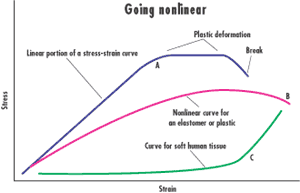
My next question was all about the interpretation of data from a “Stress versus Strain” graph. Attached is an almost-the-same graph which they showed me:
Stress

I was asked about the gradient of the graphs, Young Modulus, and identifying which object belongs to which category. The most interesting thing that I will like to point out is the professor related an item which I wrote in my personal statement, “Thera Band” to the graph. Hence, make sure that you know what you are writing in your personal statement before you go for your interview. Because this definitely proves that the professors have read your personal statement before interviewing you!

Moreover, after I finished answering this question. I was asked 2 personal questions.

1) Why do you want to study Chemical Engineering, apart from what you have written in your personal statement?
2) Why do you want to study in UK?

In conclusion, rather than calling it an interview, it is more of a stimulation of the actual tutorial system in the University of Oxford. The only reason why I can remember the questions is because I really have learnt from the interview. Personally, I felt that the purpose of the interview was not for them to eliminate students’ applications, but to find potential students who they like to teach for the next 4 years. If they find you teachable, you definitely have a high chance of succeeding the interview!

The interview is definitely something worth experiencing in your lifetime and you will certainly learn something from it!

Here’s a link that tells you further on how the admission tutors select potential students: http://www.bbc.co.uk/news/education-29222233

Christopher
Christopher Lim is a dynamic young adult who is pursuing Engineering Science- Chemical Engineering in University of Oxford under JPA scholarship. Being a fan of self- development courses and books, you will find him attending seminars after seminars especially during weekends. He is also the co-author of the book “Gen Y : Code of Success”.


Maxis Scholarship

MSEA_Home_Hero

Image Source

1. How many stages were there in your scholarship assessment?

2 stages.  Before that, I submitted an online application. In the online application, I had to write about my ambitions and also there was a separate part called the Statement of Purpose which required me to describe my career aspirations and personal attributes that would help me in achieving my ambitions.

2. What happened during your scholarship assessment?

The first stage was an informal interview. I was interviewed by two HR staff. They asked about my family background, my education experience, my personality, my aspirations etc. The two interviewers were very friendly. I felt very comfortable in that interview as it was more like chat than an interview. The interview lasted no more than 30 minutes.

The second stage was held in a boardroom where there was a panel of interviewers, including the chairman of Maxis, two professors from reputable universities, the Head of HR of Maxis and a secretary. They all held a binded copy of my portfolio/application form while interviewing me. The approximately 45-minutes interview was conducted in a more serious tone with some questions about my dreams and aspirations, why I chose to study at the university of my choice (University of Warwick), what I hope to do in the future, how would the Maxis scholarship help me (in terms of a merit-based scholarship) etc.

There was also a question asked in Bahasa Malaysia where I had to explain what TEDxKL was about, in Bahasa Malaysia.

Before I got called into the boardroom, I was waiting in another boardroom room with other interviewees. I noticed the room had a lot of cameras around, including a big conference TV. Although I was the last one to enter and exit the boardroom, I met 4 other interviewees in the room. If I remember correctly, I was waiting for over an hour in that boardroom. Naturally, I just started talking and got to know the other interviewees. Only towards the end when there were only two of us in the room (another guy and myself), I noticed the cameras. I was not sure if they were watching us but among the interviewees I met in the room, only the other guy and myself got the scholarships. I would say we were quite chatty in the room…

3. What do you think you did right to get the scholarship?

I would say my personality and my aspirations to get into education sector. It was pointed out by the panel of interviewers that it isn’t a common dream/profession – perhaps it was what that stood out in my application.

4. What are some of the past experiences that the reviewers were most interested about?

My interest in Teach For Malaysia, as a link to my future aspirations and how it was partly my interest to get involved in the education sector; and my role in TEDxKL, which was a reason why I wanted to attend the University of Warwick as I was hoping to get involved with TEDxWarwick too.

5. What advice would you give to future Maxis Scholarship applicants?

Be calm and answer everything truthfully. Try your best to apply early so that you don’t rush through your application.

It was honestly the most enjoyable interview experience I have ever gone through.

6.How did you prepare for the scholarship application?

I didn’t prepare myself with questions but only spoke to my friends and family about things that piqued my interest and attention constantly – without realising it was indirectly becoming an aspiration of mine.

Definitely invest in a good suit to look professional (I always say this and I do believe it does make a difference in your interviews), get a good night’s rest, and don’t be late for your interview!


imageedit_4_3257515162 Yin Li Toh is a second-year Economics student at the University of Warwick under the Maxis Scholarship for Excellence Award. She loves travelling whenever she can and enjoys trying out new recipes in the kitchen.

Yayasan UEM Overseas Scholarship

I am a Yayasan UEM scholar, currently studying A levels in Kolej Yayasan UEM and will be sponsored for my Undergraduate studies as well. This scholarship covers tuition fees, a laptop, accommodation and adequate living allowances. There are three stages in in Yayasan UEM Scholarship assessment.

Online application – 2000 applicants

This is just the usual application form that you need to fill in for any other scholarship application. Of course, your academic results and past experiences do make an impression at this stage. You will also need to submit two essays ( a short paragraph) here. The first one is about your interests and career plan in the subject you will be pursuing. Try to show your passion and enthusiasm in your subject and be certain about what are you going to do in your future. Since I was applying for civil engineering, I talked about my concern in sustainable development and aspire to study overseas to bring advanced technology back to Malaysia. The second one is the reason you think you deserve this scholarship. You might have to present yourself as a mature and confident all-rounder yet humble and willing to serve.

First stage – 200 candidates

UEM is a very caring company because they normally contact you through phone calls in addition to emails. After being informed about the first stage interview, I quickly did some background research about the company and some popular questions ask in interviews, this is where Mr Google and all these student aids websites come in handy.

We were first asked to write an essay within 20 minutes. The titles vary for each candidate; mine was “How to maintain the discipline in school”. Some others’ were about sports, education etc.

The following session is a personal interview. It is basically a get-to-know session where you talk about yourself. It is important to carry yourself well in this session as the first impression matters the most. Do not forget the basic courtesy such as knocking the door, greetings and smiles. My early preparation helped me with most of the session as the questions asked were the general and typical ones. The panel were very friendly and the conversation was very comfortable to me.

Here is a list of questions I was asked:

  •         Tell me about your family background and accomplishments.
  •         What inspire you in pursuing your course? (similar to the one in online application)
  •         What you did in the few months after SPM?

-I attended the three month national service and talked about the experience from it. I also took a part time job as a waitress in a local restaurant.

  •         What are your biggest strength and weakness?
  •         What are your hobbies and other interests?
  •         What are the current issues that you concern about?

You are also encouraged to ask questions at the end of the session if you have any doubts on the scholarship.

Second Stage – 50 candidates

All the candidates were divided into groups in the second stage for activities the whole day. The first game was “Name the Sports”, which we were required to act out the sports given so that others may guess. It was just an ice-breaking activity but you will still need to try stand out among other candidates. Note: the whole assessment is video-recorded for evaluation.

The second part of the assessment is group discussion. We were required to present a commercial plan for a product including marketing strategy, packaging and TV advertisement in a few hours time. You will need to show your leadership skill among the group members at the same time be cooperative with one another. Partake in the discussion and give constructive ideas at the same time value others’ opinion. Make sure everyone is involved in the presentation and utilise your own slot to present your strengths. Everyone else in the room was very bright as they were all shortlisted after several rounds of evaluation too, but do not lose your confident and just try your best. You will not even have a chance if you do not try.

Third stage – 50 candidates

During my time, all who advanced to the second stage will be progressed straight to the third stage. It was another personal interview at this time, but with the Yayasan UEM CEO and one of the directors of UEM. This session was video-recorded as well.  It was similar to the first stage as this would be the first time for the CEO meeting us. However, I faced a little difficulty when I was asked about the collapse of factory in Bangladesh a couple years back. I was not aware of that news at that time and could not answer their questions. I told them honestly, apologized and promised that I would try to keep up with the news and be more aware of what’s happening around. I actually thought that I performed badly in that interview and was very surprised when I was informed that I was offered the scholarship. Later on I found out that all the other successful scholars all thought their interviews were bad too. We made a conclusion that the panel are actually looking at how we react when we face problems that we are uncertain of. Perhaps they understand that everyone has flaws and weaknesses and the most important part is to be able to identify it and improve.

I could not be more grateful being one of the seven Yayasan UEM scholars in my batch. This is the only scholarship I applied to other than JPA Engineering Programme and it was a very competitive one as well so it was really a blessing to me. All my scholarmates have different qualities; some are very mature and outspoken, some have very deep insight to the surrounding. For me,  I believe my excellent SPM result was a big bonus in the selection. However, I believe Yayasan UEM is looking for varies qualities so do not worry if you are different from others. That will be all from me. Good luck and all the best!


imageedit_10_9519862566

Fiona Tan is a blessed girl who will is currently studying A levels under Yayasan UEM Oversea Scholarship Programme. Not knowing where she might be ended up in, she believes God has the best plan for her.

Petronas Scholarship

Overview of PESP

PETRONAS offers two types of education sponsorships to Malaysia’s most outstanding students in the oil-and-gas-related field. The first type covers from pre-university programme up to undergraduate studies, and the second covers undergraduate studies only. These sponsorships are known as the PETRONAS Education Sponsorship Programme  (PESP). They are open for undergraduate programmes at Universiti Teknologi PETRONAS (UTP) and also overseas universities. Students are allowed to choose from the list of technical and non-technical sponsored programmes to pursue in the future.

Stages involved in the scholarship application

  1. Complete an application form and submit it along with your SPM and A-Levels results and your parents’ income statements.
  2. Eligible candidates will be shortlisted and interviewed.
  3. There will be two interview stages in a day. The first one will be conducted individually and the second one will be a group interview.
    • Candidates will be grouped into teams of four or five and each team will be given a case study on different topics about the current issues happening in the world. Each candidate will be required to discuss the issue given and to solve it using different approaches stated in the papers given.
    • During the individual interview, candidates will not be asked typical questions about themselves or the company. Instead, they will be questioned about the case study.
    • After the individual interviews, all the candidates from each team will be asked to enter the room again to undergo the group interview. During the group interview, the groups are supposed to discuss among themselves and come to a conclusion as to which approach is the best to resolve the issue. The interviewers will stay quiet and observe each candidate during that period.

Atmosphere at the interview

The interviewers were really nice and friendly but also serious at the same time, especially during the first individual interview when they questioned me about the case study. There was a bit of tension as well, as you will not be able to predict what kind of questions they will ask and you will not know if the interviewers agree with what you said. However, the overall atmosphere was fine as long as you feel (or look) confident!

Advice

There is not much you could prepare for prior to the interviews besides knowing the current happenings in the world by reading more news. This is to prepare yourself for tackling the interview questions (case study). It is advisable to include any current news or latest happenings when presenting your ideas to the interviewers, e.g. I have included Soup Kitchen as a volunteering activity, which was a hot topic during that period of time and the interviewers were interested in that topic too. Besides, you should speak up and be an outstanding candidate during the group interview instead of just sitting there and listening to your other team members. However, you should also show that you are capable of being a leader by starting the conversation in the group interview when nobody else does so. Also, try to ask for the opinions of your other team members by saying, “What do you think of this idea?” etc. Last but not least, just be yourself, be confident, stay calm and may the odds be ever in your favour!


imageedit_6_7636355232Joey Chin is currently pursuing Economics at University College London (UCL) under the PETRONAS Scholarship. She manages her time well between studies and leisure because having a balanced lifestyle is crucial to her, as the saying goes, “All work and no play makes Jack a dull boy.” But of course, she knows her priorities well!

Bank Negara Kijang Emas Scholarship

Alicia Kijang Emas

Hello everyone! I’m Alicia, currently reading Law in the University of Cambridge. I was the first undergraduate student to receive the Kijang Emas scholarship from Bank Negara Malaysia (BNM), and I’ll be sharing my experiences with you today.

First, a little bit about BNM and the scholarship itself! It’s the Malaysian central bank, and is dedicated to promoting sustainable growth in Malaysia. They strongly believe in developing human capital, and BNM’s Scholarship Programme aims at nurturing young talent. I was blessed enough to receive the Kijang Emas scholarship, which is a full scholarship. Students who are awarded this particular scholarship are not bonded to BNM, and are called to contribute back to Malaysia instead. Post-SPM students who receive this also have the option to select any course in any top university. BNM also offers their scholars the opportunity to participate in internships, usually during the summer. The details of the internships depend on the particular department, but all offer great opportunities to learn.

Securing the scholarship

My application experience was a little different, as I originally applied for the normal undergraduate scholarship, but was subsequently awarded the Kijang Emas scholarship. So, I will focus instead on the general content rather than the format of my assessment. If you would like to read about the usual procedures, you can read some of the other articles on CollegeLAH by BNM scholars.

During my interview, I was generally asked about my interest in my course (Law), and how I plan to cope with studying in the United Kingdom. At this stage, it is crucial to demonstrate a keep interest in your subject, as they want students who are passionate and who really love their subject.

Among the interesting questions I was asked was whether I think it is true that some people are simply born smarter than others. My response was that we can’t control the circumstances that we are born into. Some may come into families that are better suited to expose them to the world at an early age, thus making them “smarter,” but it is up to us to make the best of what we are given.

I was also asked questions like how I handle criticism. To this, I responded that I view it objectively, and absolutely welcome it if it comes with good reason. I related this to my homework (my A Level subjects were very essay-based) to say how I use criticism to improve the quality of my work.

Intellectually, if you are still studying when you apply, you should definitely pay extra attention to your revision, and think not just about how to score in the exam, but the additional skills they provide you with as a whole (Literature, for example, hones in on analytical skills). They may very well ask what your favorite subject in college (or secondary school) is, and you should be prepared to answer this question. Read through any essays you may have submitted with your application, and reflect on some of your major extra-curricular activities, determining what qualities you have gained from them. For example, how has participating in debate helped you grow? Is it relevant to your chosen course? Has it made your more eloquent and confident? Try to put a value to everything (relevant!) that you have done, and don’t just state the obvious.

In terms of your state of mind, try not to think too much. Whilst you definitely should prepare as much as you can, don’t stress yourself out. There is only so much that you can do, and they won’t expect you to know everything anyway. Remember that there is such a thing as over-preparing! Whilst you should have the general gist of your points, don’t memorise and reproduce your answers – be as natural as you can, and show your sincerity. Once your application process is over, put it aside, and focus on what you have at hand. Don’t agonise over any mistakes you may have made (unless you know how you can improve and still have upcoming assessments). Last but certainly not least, pray very hard, and leave the rest to God!

Applying for this scholarship and receiving it has definitely affected me greatly. The application process itself taught me a lot, and I value what I learned from my interview panel during the time I spent with them too. I also got to make friends with my fellow applicants, who are all brilliant in their own right, and I hope we get to meet again in the future.

Receiving the Kijang Emas scholarship has opened my eyes to see that it is possible, and that working hard really does pay off. It has been an invaluable experience, and I am truly grateful for this opportunity.


Alicia Loh

Alicia Loh is a Bank Negara Kijang Emas scholar who will be reading Law in the University of Cambridge. She gives all glory to God. She can usually be found with a book and lots of pink, and blogs at http://www.alicialoh.com, where she writes important things about life (such as her furry baby’s first time walking on grass). She also has an online shop called Openquote Designs selling printables.

Shell Scholarship

Shell runs a very attractive scholarship program. It’s open to applicants who want to pursue their studies in a variety of destinations, be it the US, UK or even Australia, and they do not have restrictions on the degrees they sponsor. Trust me, I applied with a weird non-engineering course and got accepted. This is mainly because the Shell Program is intended as a Corporate Social Responsibility activity, which also means it has no bond (you heard me right, no bond).

First Stage

Start with applying. Go to their website and get the necessary information. Compile the needed documents and be sure to be careful enough to send all the right documents.

Second Stage

The second stage is a phone interview (in English) conducted by, I presume, a Shell employee (my interviewer’s phone number indicates she’s from India). They’ll set a date and time with you for the interview. Be on your phone during this period. Plan your day, make sure you’re not out or anywhere distracting to have this interview.

It’ll start with the usual “What are your strengths?”, “Why are these your strengths?”, and “What advantages can you offer to your team?”. It went well, until she started rolling out more difficult questions, such as “If you could start a business, tell us how, where and why.”

Take your time, gather your thoughts. She’s hoping for a well-thought-out answer. She understands that you’re being put on the spot here but that’s exactly what she wants. In a matter of minutes, you interviewer wants to gauge how much you can consider and how thorough your thinking process is.

Third Stage

Congrats! You aced your phone interview; it’s the phase where a lot of applicants get dismissed. By now you should have been invited to a venue (mine was the Intercontinental Hotel, KL) to have your interview stage. If you happen to live in Sarawak or Sabah, rest assured that they’ll pay for your expenses and accommodation. And I also found out that they allow you to bring a parent as well (they’re awesome that way).

The third stage is divided into 2 sections. In the first section, you’ll be given a case study where you have to solve real-life problems with real-life (replicated but still) documents. They’ve placed you as a manager somewhere and you have to attain your goals given your constraints.

Here’s a key thing you should know. There are no right answers but there is a ‘right’ answer. All proposed solutions are equally bad (mainly due to your constraints) but some are more unique. So it tests your ability to contextualize and choose the ‘best’ one available. You also do not have time to propose a new solution (I barely had time to finish reading the thing) but you can try.

Next, you’ll be placed into groups and given a portfolio. There your group should prioritise what the key things that your portfolio should achieve are. Here’s the catch, the other group also have their portfolio and goals, and both our groups will be placed on one table to negotiate. Again, constraints will force some choices but now you’re in direct competition with the other side. Luckily enough, my team was filled with capable arguers and we got more of our agenda onto the final paper (which I think did wonders for my chances).

After, the interviewer will hold a ‘press conference’ to grill the 2 groups on the final paper. This is where having more of your agenda will help, the interview can’t ask you hard questions. The other group however, had to engage in damage control on questions like “It seems that the solution leaned more onto the national agenda (my group) rather than the local agenda (the opposing group)”. Better hope you have a politician in your group for these questions.

And that’s the overall process. You patiently wait for their reply on whether you got the scholarship. This could come by phone or email.

General Advice for 3rd Stage

I’ll be honest, some of the best apply for this scholarship and the people who get through seem to have their own niches that make them special. At the ice-breaking session, I sat next to a Cambridge aspirant who plays some instrument for the Malaysian orchestra and the other person next to me climbed Mount Kilimanjaro (I had to Google where that was) and was going to do Geology at Imperial. Its very likely that you’ll be sitting next to very impressive people and wonder why you’re there.

Just remember this, you are there. There’s something special about you just by being there. And it’s not worth bothering yourself on ‘why’ and concentrate more on ‘why you’re there’. You want that scholarship. You can get it. You just have to keep calm and scholar up (whatever that means).


This article is written by a Shell scholar who prefers to remain anonymous.

Another Great Eastern Scholarship Application

95 Andrew Great Eastern Scholarship
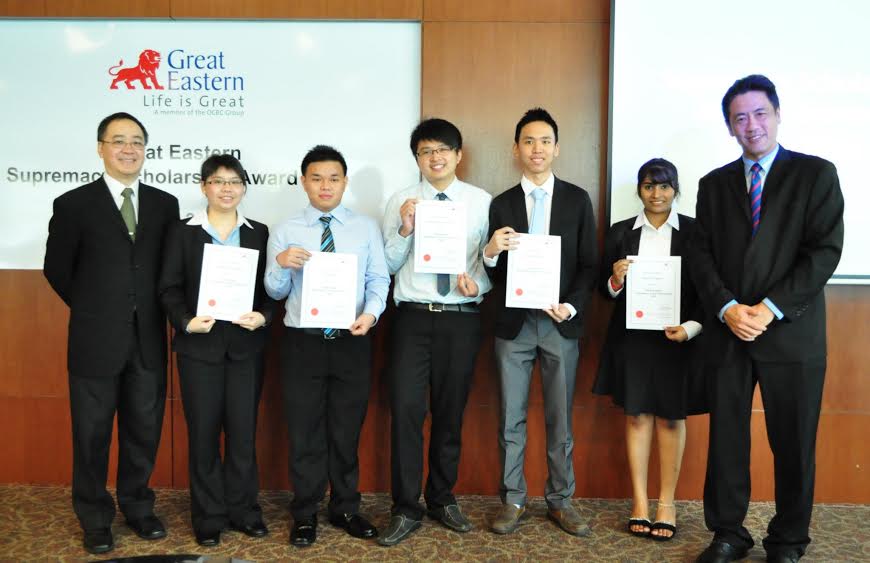
Andrew and his scholarship mates at the Great Eastern Supremacy Scholarship Award ceremony

For the uninformed, the Great Eastern Supremacy Scholarship is one of the leading education sponsorship awards in the local insurance industry scene. The scholarship program is opened for both overseas & local undergraduate programs, offering a specified quantum that covers tuition fees & living costs. For overseas applicants, only candidates applying for Actuarial Science and Accounting & Finance are considered. Meanwhile for local applicants however, the field of studies that may be considered for sponsorship encompasses a larger scope. Since its inception in 1998, the award has successfully benefited 117 students, with a cumulative human capital investment of RM7.9 million. Further technical information can be found on their website.

This year, close to half a thousand students sent in their applications to be part of this prestigious program and the numbers are just going to increase every year. With competition being this tight, how are you able to differentiate yourself? Well, let’s find out.

First Stage – Application Submission

The application form is pretty straightforward like applying for any other sponsors. A short essay to explain why you should be awarded this scholarship is not too difficult to manage.  It is very tempting to write a self-glorifying piece or fabricate false promises at this stage. My advice; do not.  Write truthfully. Slot a few assertions of your leadership qualities. A dash of compassionate points but most importantly keep it short. If English is not your first language, get a friend or lecturer to proof read your essay.

Second Stage – Preliminary Essay Writing

With your application in place, it is time to give yourself a pat on the back. You’ve gone through one of the toughest stages in the entire process; taking the first step. Now, in the spirit of professionalism, please do not pester the assessment panel every single day asking if you’ve made it through. The screening panel also has other work priorities beside you, understand that.

About after 2-3 weeks past the closing date for application submission, you should regularly check your email. If you are successful, you will receive an email from the company on your next preliminary assessment. At the time of my application, the issue that was a major focus of the country was free tertiary education. For this assessment I was required to write an essay on this topic. I was asked to elaborate my stand on the issue & critically justify my reasoning. It was to be submitted in 2 days’ time & 500 words in length.

This task is hardly to be classified as difficult unless you do not read a whole lot. The time allotted is also extremely generous for you to do enough research to write a convincing article. The only way I can see anyone failing at this stage is that they had unfortunately forgotten to check their email.

Third Stage – Panel Interview

Continuously check your email at least once a day and more so after 2 weeks have passed. Beyond this point, it is more or less safe to assume you unfortunately did not meet their expectations. This next stage in my opinion is one of the most important & therefore, I will give a very comprehensive recollection of my experience. Now it’s time for a company visit!

Upon arrival & registration, you will be invited to have breakfast, mingle with your other candidates & the Human Capital (HR) team conducting the assessment. Make full use of this opportunity to expand your network & be proactive in interacting with the staff. Although it was never clarified, but judging from my experience, scholarship assessments also focus on the silent observations of the staff strategically placed there.

You will be invited to have a brief introduction to Great Eastern as a company and the journey of evolution into the entity it is today. Do take notes actively as if you are sitting for an orientation for your first day in college. After, there will be some icebreakers. At this point, my advice is to enjoy yourself & forget that you are in an assessment.

After a short tea break, you’ll be asked individually to each come up with an essay of about 500 words. You will be given 1 hour to write, and again, it is usually a relevant topic of current issues. After, there will be lunch & more networking opportunities with some invited alumni serving their bonds in the company.

After that, you will be invited to be the main agenda; the panel interview. There will be 2 sessions of interviews with 2 panel members each, depending on who is available that particular day. You will be attending each interview session in pairs as well. Let me reinforce the fact that at this point of time, you’ll find pretty much everyone in Great Eastern is super friendly & they really are. So, relax or it could hurt your chances. Standard questions will be asked about your family background mainly as to gauge what kind of socio-economic situation your family is in. You will also be asked to reaffirm some of your CV assertions like ECA participation, letter of recommendation & forecast/actual results. Enlighten them on your aspirations & career plan. Think about how you can contribute in return and link that to your personal brand. Most importantly, show the panel you understand the commitment you are signing up for as a scholar & that you have a sound understanding of the company & industry you are about to be tied down with. The thing about Great Eastern’s interview assessment was, I felt that there was not exactly one area of focus that got me through & that they were very much more interested in you as a person. One of the more memorable questions posed to me was to market why my partner deserved the scholarship more than I do. I believe why both me and my partner advanced through this section was because we personally knew each other beforehand & therefore, we were better able to promote each other without the needs to sabotage each other, which could have been disastrous.

Before adjourning, you will also have another tea break. This is what I love about Great Eastern’s scholarship assessment. Other than the fact there is just always food around you, you will also be reimbursed for your travelling expenses! For those of you who had to catch a flight or bus to attend the assessment, you will also receive reimbursement & accommodation if necessary. All this must be prearranged beforehand, mind you.

Fourth Stage – Assessment Workshop

Alright, we’re almost there! Believe me when I say the worst is over because this next & FINAL stage of the assessment will be one really fun day. The last of you remaining will be gathered in Great Eastern for one final workshop day. The main areas of assessment will be leadership qualities.

The first main agenda for me that day was to create a mind map to explain some unique tidbits about myself. Even if you lacked artistic qualities, impress both the panel & audience with how much you know about yourself & articulate the flow of information well. A leader is a person who knows himself/herself better than anyone else.

Next assessment would be an advantage for those of you who have a background in Toastmasters. I was asked to draw a table topic from a bowl & asked to speak on my feet. As a leader, giving a speech, be it informative or opinionated, should be a knee-jerk reaction by now. Not only does the quality of your matter is important, but the structure is also imperative. The same goes to say for your mannerism or your body language. I also remember taking Q&A’s from the audience on my topic with some coming from the Human Capital team.

Next, all of us were taken to an assessment centre where you will be required to complete a digital aptitude test on our mathematical abilities & work personality survey. I recall both had a specified time limit that you needed to complete in but it was not a very tight one. Take your time, gather your thoughts and relax. Do not feel pressured if someone else finishes faster than you because at the end of the day, it is the quality of your answers that matters, not your speed of your completing.

Following up after a delicious lunch break, all of us were divided into two groups for some group assessments. The more memorable one that was important was the case study & solution pitching session. I remember our topic of the day was regarding creating a product awareness of Takaful insurance products. We were then asked to critically evaluate & debate each other’s solutions in an impromptu manner. At this point, I was enjoying myself too much to be really focused on recollecting what happened that day & I figured that this was their intention. It was simply to conduct a session of bonding amongst ourselves. We found out later that every attendee of the final phase received a scholarship offer, except one person due to the unique circumstances of his undergraduate study offer.

Parting Words

Many people (particularly my batch) did not really know or paid serious attention at the prospect of attaining a scholarship with Great Eastern. In fact, I ALMOST skipped applying for it (which I did for many other scholarship opportunities) mainly because it was not as glamorous in comparison to likes of say, Khazanah or BNM. I was also discouraged at the thought of rejection due to my less than stellar forecast results. Besides, I had just been rejected for almost every other scholarship I had applied to that year. Nevertheless, it is never an excuse to not try. Even if you did not meet some requirements or your chosen field of study is not mentioned, you risk nothing applying!  Be proactive in shaping your future, because no one else will do it for you.

DISCLAIMER:

This is a recollection of an event that transpired almost 3 years ago. Chances are the assessment will not be exactly the same, even more so that the scholarship coordinator & team have changed since then.


imageedit_8_7814793404Andrew Chin Chee Loong is a recipient of the Great Eastern Supremacy Scholarship & is currently reading Accounting & Finance in HELP University, under the University of London External Programme. He’s also part of the university’s student representative council & has recently joined a student organization known as the International Council of Malaysian Scholars & Associates (ICMS). When he’s able to find the time to settle down with a good book, he loves reading fiction, preferably dystopian & sci-fi.

Medicine Twinning Programme in Penang and Ireland

cropped-ucd_2014_niceone_11

Image Source

Hello everyone! Greetings from the land of Leprechauns and everything green!! If you are reading this article, that means you have at least a slight interest in studying Medicine in Ireland!! Well, first let me introduce myself! I am Yeo Chun Huay from Subang Jaya, currently studying medicine in University College Dublin, Ireland! I did the Cambridge A-Levels course in Taylor’s College Subang Jaya, which, I must say, helps a lot when you reach university since you would have covered quite a lot of things back in the A-Levels programme!

Now, I am actually in the Penang Medical College program, which is a twinning program. The pre-clinical years (2.5 years) will be done here in Dublin, Ireland while the clinical years (2.5 years) will be done back in Penang, Malaysia. This is a choice for people who missed out on the IUMC dates, or didn’t meet the requirements for it. For people who don’t know what IUMC is, it’s the Irish Universities and Medical Schools Consortium. That’s where you need to apply to if you are looking for a full 5-year/6-year medicine course in Ireland. For this article, I’m just going to tell you guys about the Penang Medical College programme. You don’t need to write a personal statement or anything to enter. Basically, the process is actually quite easy. All you need to do is fill out the registration form, hand it in and wait for your interview date. Once you’ve got your interview date, you have to travel to Penang (if you don’t already live there) for the interview.

For the interview, I have to say that not much preparation is needed. The common question I think was a typical medical school question, “Why do you wanna be a doctor?” Get the answer to that in your mind before you enter and you should be fine. Basically the interview is more of a confirmation from them just to check if you are serious in pursuing this medicine course and not drop out half-way. It’s a solo interview so please don’t get nerve spasms! The interviewer was quite friendly for me so you guys should have no problem. It’s most probably going to be more of a discussion than an interview anyway! If everything goes well, you will get your offer letter in matter of days or if you are lucky then in a few hours!

After getting the offer, there are some things to be done too. Health check is compulsory just to check for Hepatitis B Antigens and to get your Hep B Vaccine. IELTS is also a necessity, so you need to score a 6.5 average and a minimum of 6.0 in each of the four sections of the test. IELTS wasn’t really a very hard English test for me since I have a good English foundation since young. Some tips to get you through IELTS is just to do their sample tests or watch any videos on the test you can find on YouTube! There really isn’t any point in spending a lot of money to attend their workshop since you can find everything online anyway. Just don’t panic on the day of the test and you will be fine. Apparently you can do TOEFL instead of IELTS but I went for IELTS so you need to check that yourself. For attachments, personally I’ve never had any hospital attachments before I came here to Ireland so it’s not a compulsory thing, but you may do it just to get some exposure to the medical world. Volunteer jobs are entirely up to you; if you think that they help you then by all means go ahead!

There’s one more thing that I would like to add! On the website, the deadline for the registration for PMC is in February. But I actually applied in August and kind of rushed through my application in a month, and I arrived in Dublin on September the 1st! Although I got through within a month, please don’t be like me; apply earlier, please! The process of rushing is so not fun. NOT FUN AT ALL! Also, if you apply earlier at least you will have a goal to spur you through your A-Levels! So just to remind you, set your path as early as you can!

That basically wraps up your application process for studying in Ireland through the PMC Programme. Since I was an A-Level student, here are some tips and reminders for you guys about the CAL programme. Study hard and look around for scholarships while you are at it. Although medical scholarships are super rare, just keep an eye out or discuss with your friends. For you guys who are going to sit for AS, score as high as possible, while you guys who are sitting for A2 soon, keep doing past years and you should be fine. Heck, I did better in A2 than in AS!  Most importantly, don’t miss out on deadlines for applications! That can scar you for life, or just wait another year! Just in case some of you don’t know, Ireland is part of the European Union and not the United Kingdom, so prices for everything here is in Euro! Hope you guys have a pleasant time applying to come to Ireland! It’s a grand place and I’m sure you are going to like it here. Hope to see you guys here. Cheers!

P.s: Here are the minimum requirements for the PMC programme!

Yeo Chun Huay
1st year Medical Student in UCD (Stage 2)
8 October 2014


imageedit_6_2917902026

Yeo Chun Huay is a self-funded student currently pursuing his medicine degree in University College Dublin. He will be returning to Penang Medical College in 2017 with students from both UCD and Royal College Surgeons Ireland (RCSI). He has one motto in Ireland, if its free, don’t complain!

Application to Cambridge Engineering

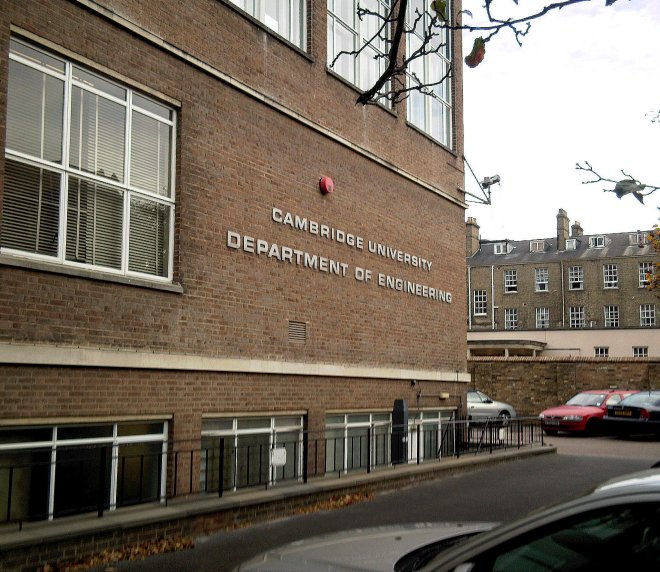
19-10-09: Cambridge University Department of Engineering

Image Source

About Myself

Hi! My name is Gan Jia Min. After graduating from KDU University College A Levels, I headed off to the University of Cambridge in October 2014 to study Engineering.

Engineering In Cambridge

The Engineering course in Cambridge is designed such that all would-be engineers (with the exception of chemical engineers) have a common first TWO years (meaning the same courses, etc). Chemical engineers only have a common first year. The good part about this is that if you are still uncertain about which field of engineering you would like to specialise in (for instance civil, mechanical, electrical), the common first two years allow you to explore the different fields of engineering in greater depth before you ultimately make an informed decision. However, let us say you are certain that you would like to be a computer engineer; it may seem redundant to learn how beams bend when subjected to a load or to learn the properties of steel in your first two years whilst your peers at other universities are learning (for the most part) purely computer engineering modules. For more information about how the Engineering course is structured, you may like to visit http://www.study.cam.ac.uk/undergraduate/courses/engineering/

Application Procedure

There are 5 simple steps to follow if you wish to apply for Engineering in Cambridge.

Firstly, fill up your UCAS online application. You will need to include a personal statement in this form.

Secondly, find out if you have to fill up another online form called COPA (Cambridge Online Preliminary Application), which can be found here (international applicants have to fill this up, so if you’re applying from Malaysia, you have to submit this).

Fill it up if you are required to and submit it before the deadline.

Thirdly, fill up another online form called SAQ (Supplementary Application Questionnaire). If you have already filled up the COPA form previously, you should indicate that you have done so and you will be guided to the relevant section of the SAQ to submit the form. Again, please check the deadline of submission of these forms.

Next, keep your fingers crossed and wait for an email inviting you to an interview and a written test.  The interview and the written test are most likely to be within a few days of each other.

Lastly, wait for their decision, whether or not to accept, reject or pool you. This decision can come via email or (more traditionally) by post, which could take up to a week or longer than by e-mail. Whether or not you will be notified by e-mail or post will depend on which college in Cambridge you applied to.

Personal Statement

It is important to show the university that you are passionate about your chosen course. In doing so, you may want to elaborate on what inspired you to pursue Engineering in the first place. For me, I wrote about how the construction of the Petronas Twin Towers coupled with my love for Mathematics and Physics fuelled my passion for Engineering.

As far as personal statements are concerned, words have little meaning if you cannot back them up with actions. Elaborate on what you have done to learn more about Engineering. For example, reading a relevant book, fixing a bicycle or signing up for an attachment at an engineering firm. Merely stating “I have fixed a bicycle before” is not good enough because it sounds shallow. Elaborate on what needed fixing and how you did it. Explain what you have learnt from this and how it relates to your passion for engineering.

You should include any relevant ECAs as well. For example, an engineering competition you participated in. Once again, add depth to your points. What have you learnt from the competition, etc. Personally, I wrote about the experience and knowledge I gained from participating in several Mathematics competition as well as a Surveyors’ competition.

Of course if possible, your personal statement should be proofread by someone experienced. If you are in Malaysia, MABECS offers this service free of charge (http://www.mabecs.com/).

Interview

If you wish to be interviewed in Malaysia, you will only be interviewed once before your college decides to accept, reject or pool you. Note that you may be re-interviewed via Skype by another college if you are pooled.

Before attending your interview, make sure you know what you have written in your personal statement inside out. If you talked about reading a book, make sure you really know the book because the interviewer can ask you about it. Also, revise your school work, especially the chapters you said you would have covered by the date of the interview in your COPA. These are usually rich sources of questions.

During the interview, you will be asked academic questions. Try your best to answer them. Make sure you think aloud. It is important that the interviewer knows your train of thought. Whenever you get stuck, do not worry, the interviewer will give you hints for you to proceed.

Engineering applicants are, not surprisingly, usually asked Mathematics and Physics questions. Usually the questions will start simple, and then become more complex as you go along. Very frequently, you will be asked unfamiliar questions and be expected to apply what you have learnt in that situation. Let us look at two questions I made up below.

A usual Mathematics question will be graph sketching. Say, sketch y=x and y=sinx. So far, so simple. One is a straight line through the origin and the other a sinusoidal graph. Then, maybe, you will be asked to sketch y=(sinx)/x. This may not be immediately obvious. However, do not panic. Remember, think aloud. You may not immediately know the answer, but tell the interviewer how you wish to proceed. For instance, you could say for x>0, as x increases, the denominator increases whereas the numerator oscillates from 1 to -1 and back to 1 again. So, as x increases (for x>0), (sinx)/x must also be oscillating with decreasing amplitude. After that, the interviewer may ask you to sketch y=xsinx. The point here is, tell the interviewer your train of thought. Do not remain silent.

Let us look at another example. An engineer must be good at estimating quantities. Many errors can be avoided if you have a rough idea how large a number should be. So maybe the interviewer can ask you to estimate the mass of oxygen in the room you are in. So, once again, explain to the interviewer how you wish to tackle the question. Maybe you can estimate the dimensions of the room, and from that, its volume. Then maybe you proceed to say oxygen makes up approximately 20% by volume of our atmosphere. From the volume, you can use the ideal gas equation to estimate the number of moles of oxygen molecules and multiply this with the Relative Molecular Mass of O2.

Written Test

All Engineering applicants will have to sit for the TSA (Thinking Skills Assessment). You will also have to write an essay about engineering from five choices. All I did to prepare for the TSA was to do a specimen test they have online which can be found here.

I did it just to get a feel of what kinds of questions they will be asking. Remember though, to always keep an eye on the clock. Otherwise, you may not be able to finish it on time, especially if you are not a fast reader.

All I did to prepare for the essay was to once again revise my school work. It is pretty much the same preparation as for the interview.


imageedit_4_8404278516Gan Jia Min is a Math/Physics lover who is pursuing his Engineering degree in the University of Cambridge under a JPA Scholarship. One of his prouder achievements was to become the high jump champion in his primary school in Primary 5!